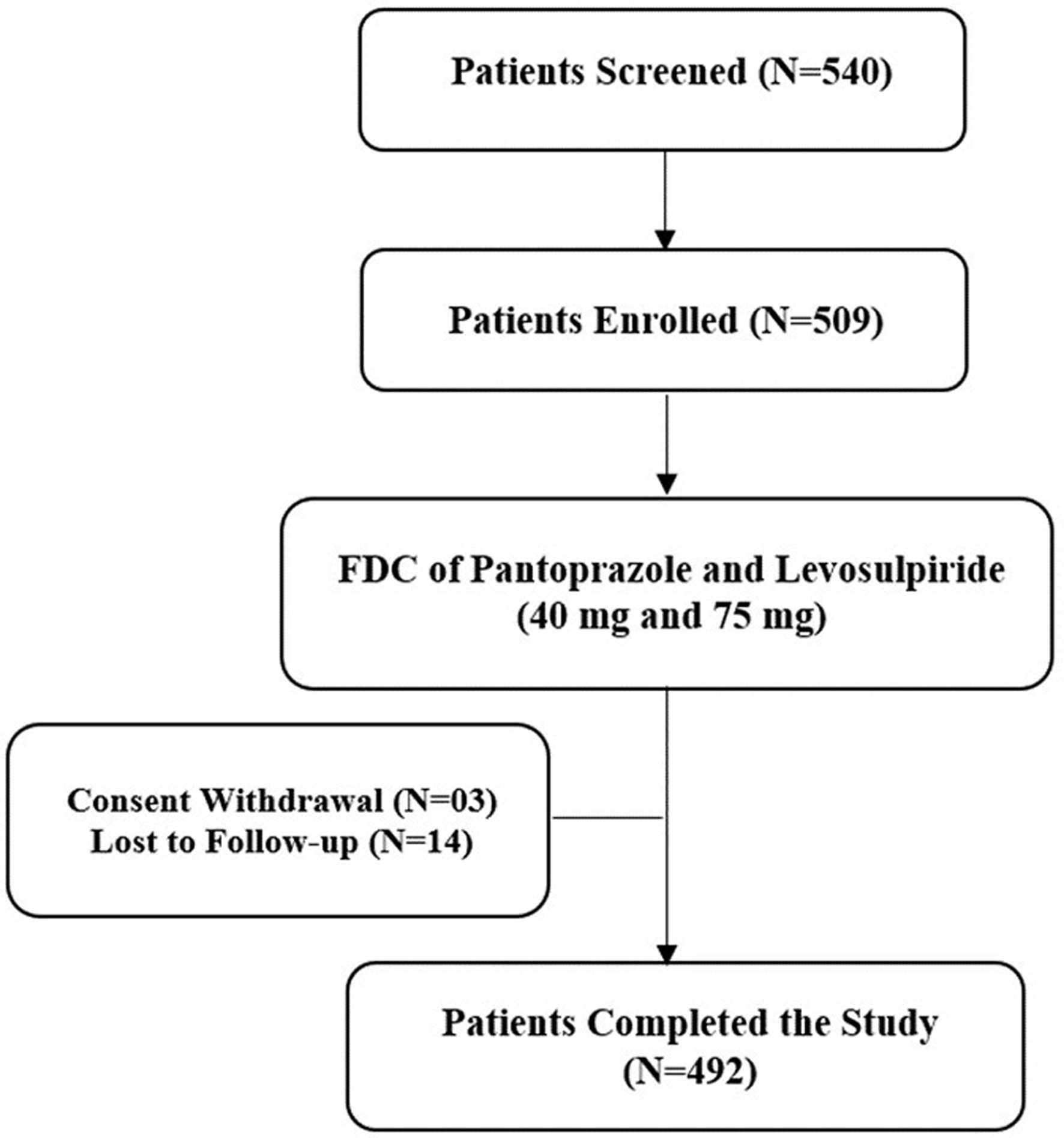
↓ Figure 1. Study design.

| Gastroenterology Research, ISSN 1918-2805 print, 1918-2813 online, Open Access |
| Article copyright, the authors; Journal compilation copyright, Gastroenterol Res and Elmer Press Inc |
| Journal website https://gr.elmerpub.com |
Original Article
Volume 19, Number 4, August 2026, pages 233-242
Safety and Efficacy of Fixed-Dose Pantoprazole and Sustained Release Levosulpiride for Short-Term Management of Gastroesophageal Reflux Disease
Figures
Tables
| System organ class: preferred term | FDC of pantoprazole sodium + levosulpiride SR capsules (N = 509) | Severity of adverse events | |
|---|---|---|---|
| Mild | Moderate | ||
| FDC: fixed-dose combination; SR: sustained release. | |||
| Abdominal pain | 1 (0.2%) | 1 (0.2%) | 0 |
| Constipation | 1 (0.2%) | 1 (0.2%) | 0 |
| Diarrhea | 3 (0.6%) | 2 (0.4%) | 1 (0.2%) |
| Nausea | 2 (0.4%) | 2 (0.4%) | 0 |
| Pyrexia | 5 (1%) | 1 (0.2%) | 4 (0.8%) |
| Nasopharyngitis | 1 (0.2%) | 1 (0.2%) | 0 |
| Rhinitis | 2 (0.4%) | 0 | 2 (0.4%) |
| Urinary tract infection | 3 (0.6%) | 0 | 3 (0.6%) |
| Blood prolactin increased | 50 (9.8%) | 10 (2%) | 40 (7.9%) |
| Dizziness | 1 (0.2%) | 1 (0.2%) | 0 |
| Headache | 6 (1.2%) | 4 (0.8%) | 2 (0.4%) |
| Testicular pain | 1 (0.2%) | 1 (0.2%) | 0 |
| Cough | 1 (0.2%) | 0 | 1 (0.2%) |
| Oropharyngeal pain | 1 (0.2%) | 1 (0.2%) | 0 |
| Rhinitis allergic | 1 (0.2%) | 1 (0.2%) | 0 |
| Statistics summary | Visit 2 (day 0) (N = 509) | Visit 3 (day 14 ± 2) (N = 507) | Visit 4 (day 28 ± 2) (N = 492) |
|---|---|---|---|
| Normal | 508 (99.8%) | 507 (100%) | 492 (100%) |
| Minimal degree of movement disorder | 1 (0.2%) | 0 (0.0%) | 0 (0.0%) |
| Clinically significant degree of movement disorder | 0 (0.0%) | 0 (0.0%) | 0 (0.0%) |
| Severe degree of movement disorder is present | 0 (0.0%) | 0 (0.0%) | 0 (0.0%) |