Gastroenterology Research, ISSN 1918-2805 print, 1918-2813 online, Open Access
Article copyright, the authors; Journal compilation copyright, Gastroenterol Res and Elmer Press Inc
Journal website https://gr.elmerpub.com

Review

Volume 000, Number 000, October 2026, pages 000-000


Prescribe, Co-Manage, or Refer? A Practical Approach for Incretin-Based Obesity Therapy in Gastroenterology Practice

Figure

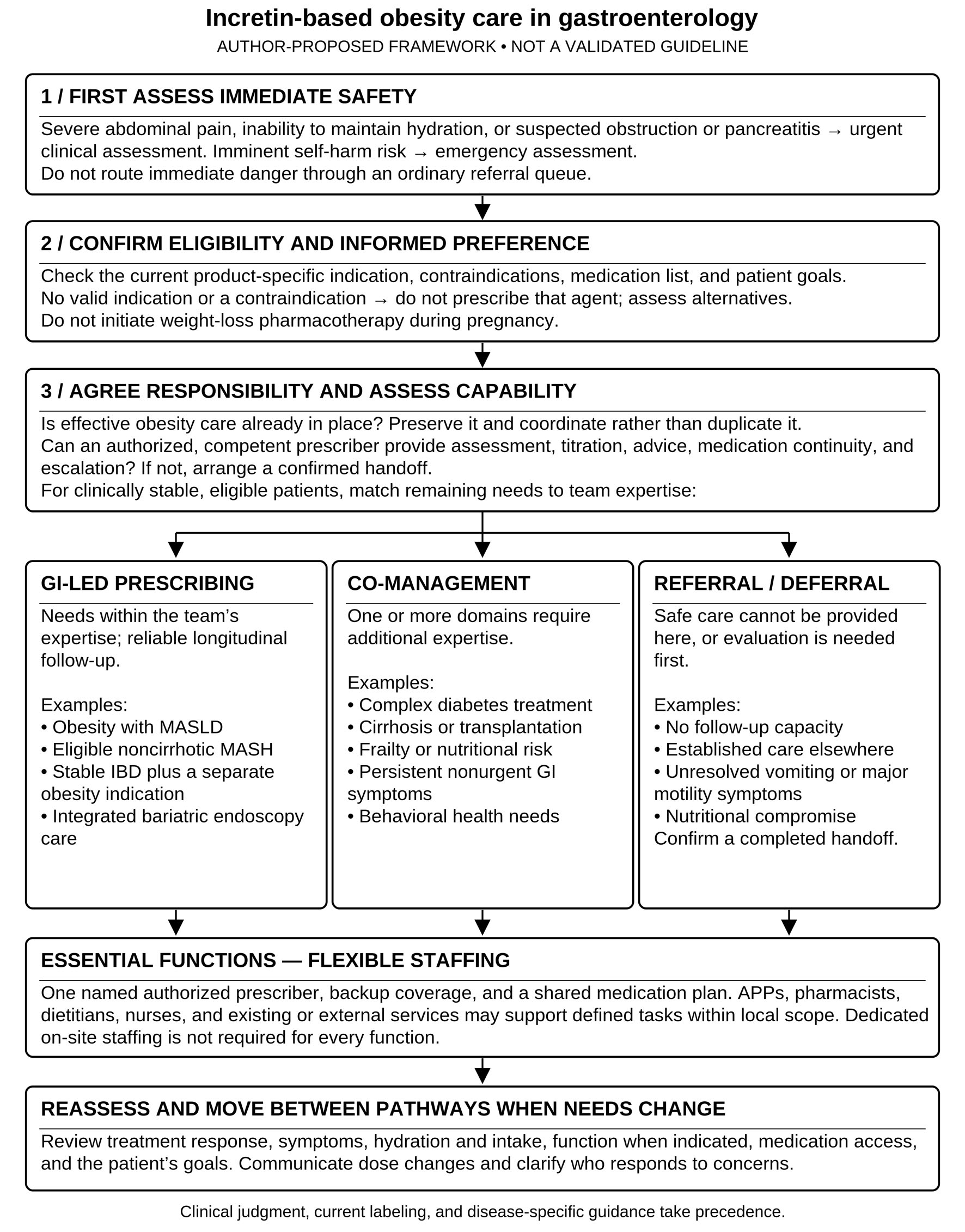
↓  Figure 1. Proposed care-allocation algorithm for incretin-based obesity therapy in gastroenterology. Immediate safety concerns and product-specific eligibility are considered before choosing a care setting. Examples within each pathway are author-proposed routing considerations, not validated thresholds. Co-management depends on patient needs relative to clinician expertise. A trained physician or advanced practice provider may be the accountable prescriber when authorized; pharmacists and other professionals support defined functions within local scope. Severe symptoms require timely assessment rather than an ordinary referral queue. The framework supplements, and does not replace, labeling, disease-specific guidance, or clinical judgment. APP: advanced practice provider; GI: gastroenterology; IBD: inflammatory bowel disease; MASLD: metabolic dysfunction-associated steatotic liver disease; MASH: metabolic dysfunction-associated steatohepatitis.
Figure 1.

Tables

↓  Table 1. Proposed Prescribe–Co-Manage–Refer Pathways
 
Care-model domainGI-led prescribingCo-managementReferral/defer initiation
Author-proposed and unvalidated. GI-led denotes a gastroenterology service, not physician-only care. Apply current labeling and local scope-of-practice rules. APP: advanced practice provider; GI: gastroenterology; IBD: inflammatory bowel disease; MASLD: metabolic dysfunction-associated steatotic liver disease; MASH: metabolic dysfunction-associated steatohepatitis.
Best fit and representative scenariosAppropriate indication and longitudinal GI follow-up within team competence: obesity with MASLD; eligible noncirrhotic MASH; or stable IBD with a separate obesity indication and adequate nutrition.Additional expertise needed for complex diabetes, cirrhosis or transplantation, nutritional vulnerability, persistent nonurgent GI symptoms, or behavioral health concerns.No GI follow-up capacity, effective obesity care elsewhere, or unresolved vomiting, major motility symptoms, malnutrition, or pregnancy-related concerns requiring assessment.
Prescribing responsibilityOne authorized GI physician or APP directs selection, titration, adverse-effect decisions, response assessment, and maintenance. Document backup coverage.One prescriber directs incretin therapy. Collaborators accept defined tasks, such as insulin adjustment, nutrition assessment, or transplant monitoring. Communicate dose changes.Confirm an accepted handoff and interim responsibility. Continue indicated GI care. A contraindication is not a reason to seek another prescriber for the same drug.
APP responsibilitiesAssess, prescribe when authorized, educate, follow up, and triage within competence. An APP may be the accountable prescriber, with consultation available.Coordinate follow-up, agreed actions, and communication. Adjust treatment only within the shared plan and authorized scope.Facilitate referral completion, transmit records, and provide agreed interim triage. Escalate concerns that cannot safely wait.
Clinical pharmacist responsibilitiesReconcile medications; support selection, access, device education, interaction review, and restart decisions. Titrate or prescribe only where authorized.Reconcile cross-specialty changes and coordinate medication access, titration support, and drug monitoring with responsible clinicians.Identify duplicate or externally obtained products, reconcile doses, and support transitions. Shared or community pharmacy may provide these functions.
Follow-up and reassessmentReview tolerability before dose increases, symptoms, intake, hydration, access, goals, and response. Monitor function in patients at risk.Assign result review and patient contact. Avoid unnecessary duplicate visits or testing. Reconsider the pathway after stabilization.Track the handoff and referral completion. Communicate last dose, symptoms, pending assessments, and the interim plan.
Safety safeguards and pathway transitionsAdd expertise or transfer care when needs exceed capacity. Continuing GI-led treatment is not a goal in itself.Use one communicated medication plan and clear symptom-escalation arrangements. Return to GI-led care when additional support is no longer needed.Severe pain, inability to maintain fluids, or suspected obstruction/pancreatitis: urgent assessment, not routine referral. Imminent self-harm risk: emergency assessment.


↓  Table 2. Essential Safety Functions and Flexible Program Resources
 
Care functionProposed essential safety functionDesirable capability/feasible alternative
All service-configuration recommendations in this table are author proposals. Essential refers to the safety function, not a mandated staffing model or a society-endorsed minimum standard. Clinical actions remain subject to product labeling and relevant guidance. APP: advanced practice provider; GI: gastrointestinal or gastroenterology; GLP-1: glucagon-like peptide-1.
Competent and accountable prescribingAn authorized clinician assesses indication, current labeling, contraindications, dose changes, and need for consultation. A named prescriber and backup are documented.Focused education, supervised experience, and protocols. Certification or a dedicated obesity service may help but is not a universal entry requirement.
Baseline assessment and shared decisionsDocument indication, weight history, medications, GI symptoms, nutritional and reproductive risks, patient goals, alternatives, and existing obesity care.Structured intake with an APP, nurse, or pharmacist. Reuse clinically useful existing records rather than require duplicate testing.
Titration and symptom responseArrange follow-up, accessible advice, label-consistent dose changes, and urgent escalation for serious symptoms before prescribing.APP- or pharmacist-supported visits, remote contacts, or a shared service. The prescribing clinician may provide the same functions.
Medication reconciliation and continuityAssign responsibility for refills, access interruptions, actual product and dose, and restart or transition decisions. Avoid duplicate semaglutide/tirzepatide products or overlapping GLP-1 receptor agonists.On-site clinical pharmacy or a collaborative-practice service; alternatively, existing staff and a community pharmacist with clear communication.
Nutritional and functional safetyAssess intake and hydration, identify high-risk patients, and arrange further assessment when indicated. Do not monitor weight alone in vulnerable patients.Nutrition, physical therapy, or exercise expertise through on-site, shared, or external services. Body-composition testing for selected indications, not every patient.
Procedure coordinationDocument the medication, last dose, escalation phase, and relevant symptoms. Communicate with the endoscopy and anesthesia teams when a procedure is planned.A shared preprocedure checklist and a locally agreed risk-assessment protocol, rather than a separate obesity-specific procedural service.
Co-management and referralArrange necessary expertise, transmit the clinical question and care plan, and confirm responsibility for medication changes, symptoms, and follow-up during transitions.Shared records, referral agreements, or a concise handoff message. Access to appropriate expertise is more important than on-site employment.
Review of service performanceReassess individual benefit, tolerability, continued indication, and access barriers.A small registry or audit using selected measures in Supplementary Material 2 (gr.elmerpub.com). A comprehensive registry is not a prerequisite for safe care.