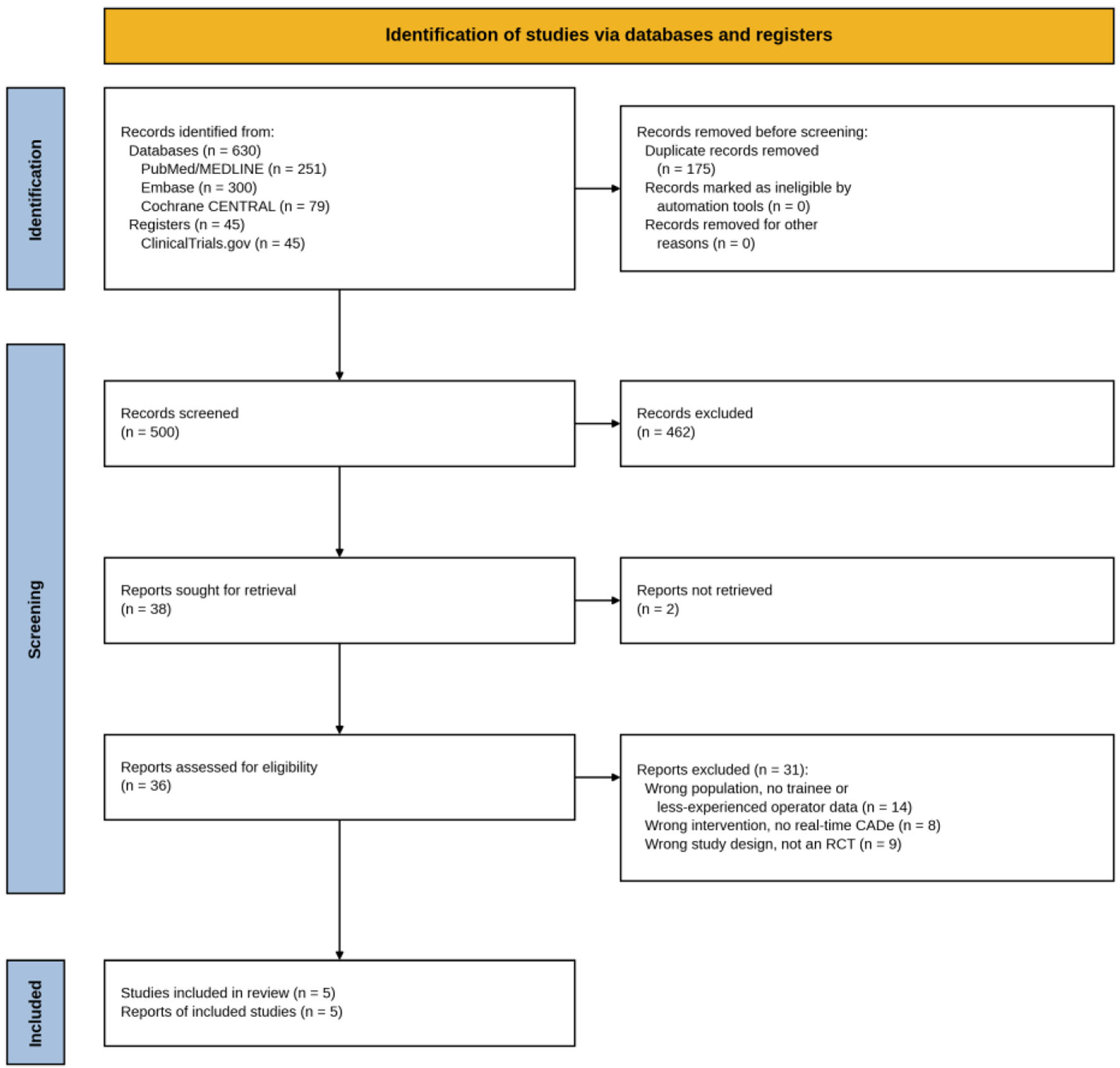
↓ Figure 1. PRISMA 2020 flow diagram of study selection, showing the number of records retrieved from each database and register searched.
| Gastroenterology Research, ISSN 1918-2805 print, 1918-2813 online, Open Access |
| Article copyright, the authors; Journal compilation copyright, Gastroenterol Res and Elmer Press Inc |
| Journal website https://gr.elmerpub.com |
Original Article
Volume 000, Number 000, October 2026, pages 000-000
Artificial Intelligence-Assisted Colonoscopy Improves Adenoma Detection by Trainee and Less-Experienced Endoscopists: A Systematic Review and Meta-Analysis of Randomized Controlled Trials
Figures
Tables
| Study (year) | Country | Design | CADe system | Operator category | Operator definition | CADe n | Control n | Total n |
|---|---|---|---|---|---|---|---|---|
| “Trainee” denotes operators enrolled in formal endoscopic training; “less-experienced” denotes independently practicing operators below an investigator-defined lifetime procedure threshold. Counts are the numbers of patients analyzed in each arm. For the two tandem trials (Yamaguchi 2024, Yao 2024), counts and outcomes refer to the trainee-performed first pass. AID-2: Artificial Intelligence Detection 2 trial; CADe: computer-aided detection; CNN: convolutional neural network; ENDOAID-TRAIN: ENDO-AID in Endoscopists-in-Training trial; PGY: postgraduate year; RCT: randomized controlled trial; USA: United States of America. | ||||||||
| Repici 2022 (AID-2) [20] | Italy; Switzerland | Parallel RCT | GI Genius (Medtronic) | Less experienced | Independently practicing non-experts (< 2,000 lifetime colonoscopies) | 330 | 330 | 660 |
| Lau 2024 (ENDOAID-TRAIN) [21] | Hong Kong | Parallel RCT | ENDO-AID (Olympus) | Trainee | Endoscopists-in-training (< 500 procedures, < 3 years of training) | 386 | 380 | 766 |
| Yamaguchi 2024 [23] | Japan | Back-to-back tandem RCT | CAD EYE (Fujifilm) | Trainee | Trainees (0–20 prior colonoscopies) | 113 | 118 | 231 |
| Yao 2024 [24] | China | Multicenter back-to-back tandem RCT | Custom CNN (EndoAngel) | Trainee | Novices (no prior colonoscopy experience) | 227 | 229 | 456 |
| Chang 2026 [22] | USA | Pragmatic parallel RCT (room- and fellow-level randomization) | GI Genius (Medtronic) | Trainee | Gastroenterology fellows (PGY 4–6) | 401 | 644 | 1,045 |
| Total | 1,457 | 1,701 | 3,158 | |||||
| Characteristic | Repici 2022 (AID-2) [20] | Lau 2024 [21] | Yamaguchi 2024 [23] | Yao 2024 [24] | Chang 2026 [22] |
|---|---|---|---|---|---|
| Values are n, n (%), or mean ± standard deviation unless otherwise stated, and are presented as CADe arm/control arm where both are available. Data are as reported in the primary publications; where a trial reported a characteristic only for the whole cohort rather than by arm, this is indicated, and NR denotes a characteristic not reported in the source publication. ADR: adenoma detection rate; AID-2: Artificial Intelligence Detection 2 trial; BBPS: Boston Bowel Preparation Scale; CADe: computer-aided detection; CADx: computer-aided diagnosis; CAQ: computer-aided quality; CNN: convolutional neural network; FDA: United States Food and Drug Administration; FIT: fecal immunochemical test; GI: gastrointestinal; IQR: interquartile range; NR: not reported in the source publication; PGY: postgraduate year. | |||||
| Participant characteristics | |||||
| Patients analyzed (CADe/control) | 330/330 | 386/380 | 113/118 | 227/229 | 401/644 |
| Age, years | 62.3 ± 10 (whole cohort) | 66.00 ± 10.05/65.36 ± 11.33 | 63.1 ± 10.8/63.3 ± 11.8 | 50.63 ± 12.25/49.85 ± 11.68 | 54.6 ± 11.6/54.2 ± 12.2 |
| Female sex | 330/660 (50.0%) (whole cohort) | 181/386 (46.9%)/169/380 (44.5%) | 55/113 (48.7%)/52/118 (44.1%) | 110/227 (48.5%)/106/229 (46.3%) | 168/401 (41.9%)/287/644 (44.6%) |
| Colonoscopy indication | Screening, surveillance, or diagnostic | Screening 7.3%/6.1%; surveillance 32.6%/31.8%; symptomatic 60.1%/62.1% | FIT-positive 46.9%/54.2%; detailed examination 19.5%/22.0%; polyp surveillance 13.3%/11.0%; abdominal symptoms 11.5%/8.5%; other 8.9%/4.2% | Screening 63.9%/63.8%; diagnostic 26.4%/28.0%; surveillance 9.7%/8.3% | GI bleeding 52%/57%; symptoms 17%/17%; surveillance for neoplasia 13%/12%; screening 14%/11%; imaging follow-up 3%/2% |
| History of previous adenoma | Not separately reported; surveillance included as an eligible indication | Not separately reported; surveillance 32.6%/31.8%. Family history of colorectal cancer 19.5%/15.6% | Polyp surveillance 15/113 (13.3%)/13/118 (11.0%); family history of colorectal cancer 11.5%/11.0% | Not separately reported; surveillance 9.7%/8.3%. Family history 8.8%/7.0% | Not separately reported; surveillance for neoplasia 13%/12%. Family history of colon cancer 8%/7% |
| Bowel preparation quality | NR | BBPS total 7.85 ± 1.17/7.84 ± 1.21; patients with BBPS 0-1 in any segment excluded | Modified Aronchick excellent or good 86.7%/83.9%; BBPS whole colon 8.4 ± 1.2/8.2 ± 1.5 | BBPS adequate (sum ≥6.0 and each segment ≥2.0) 86.3%/88.2% | NR by arm |
| Baseline control-arm ADR | 44.5% | 44.5% | 61.0% | 16.2% | 34.9% |
| Operator characteristics | |||||
| Number of operators | 10 | 22 junior endoscopists | 6 trainees | 8 novices (plus 10 experts for the second pass) | 16 fellows |
| Specialty | Gastroenterology/endoscopy | Gastroenterologists (78.8%/76.3% of procedures) and surgeons-in-training (21.2%/23.7%) | Gastroenterology | Gastroenterology | Gastroenterology |
| Formal training status | No, independently practicing | Yes, endoscopists-in-training | Yes, trainees who had started fellowship training | Yes, fellows in training | Yes, GI fellows, PGY 4–6 |
| Years of endoscopy experience | NR; qualified for independent screening colonoscopy and non-complex therapy | < 3 years of training | First year of fellowship training | 0 years of independent colonoscopy; > 1 year of gastroenterology fellowship | 1st to 3rd year of fellowship |
| Lifetime colonoscopies performed | < 2,000 per operator | < 500 per operator | 0–20 cases per operator | 0 prior independent colonoscopies; 20 supervised colonoscopies with expert hands-on training before study entry | Median 84 (IQR 54–127) for PGY 4; 327 (IQR 272–373) for PGY 5; 468 for PGY 6 |
| Experience strata used by investigators | Single stratum (non-expert, < 2,000 procedures) | Beginner (< 200 procedures, n = 12) and intermediate (200–500 procedures, n = 10) | Single stratum | Novice versus expert (expert defined as ≥5,000 colonoscopies) | Fellow year 1 (PGY 4), year 2 (PGY 5), year 3 (PGY 6) |
| Prior experience with CADe | NR | Yes, all junior endoscopists received training on the CADe system before study initiation | NR | None reported | NR |
| Intervention characteristics | |||||
| CADe platform | GI Genius | ENDO-AID | CAD EYE | EndoAngel (custom CNN) | GI Genius |
| Manufacturer | Medtronic, Dublin, Ireland | Olympus, Tokyo, Japan | Fujifilm, Tokyo, Japan | Renmin Hospital of Wuhan University, Wuhan, China | Medtronic, Dublin, Ireland |
| Software/version | NR | Preinstalled on the EVIS X1 CV-1500 processor | NR | Custom deep-learning system on a dedicated host computer | US FDA-approved system; version NR |
| Visual alerts | Yes, real-time on-screen marking of candidate lesions | Yes, alert flag with picture-in-picture display in normal mode; a target mode is also available | Yes, real-time on-screen marking of candidate lesions | Yes, real-time on-screen marking of candidate lesions | Yes, real-time on-screen marking of candidate lesions |
| Auditory alerts | NR | NR | NR | NR | NR |
| CADe active during insertion | No | No | No, colonoscope inserted without CAD EYE in both groups | No | No |
| CADe active during withdrawal | Yes | Yes | Yes | Yes | Yes |
| Additional computer-aided diagnosis (CADx) | No | No | Yes, CADx used to characterize lesions when measuring polyps | No | No |
| Additional computer-aided quality (CAQ) or withdrawal-speed feedback | No | No | No | Yes, computer-aided quality system providing withdrawal-speed and mucosal-exposure feedback | No |
| Other co-interventions | None | On-site or next-door supervisor available for safety | Expert second pass without CAD EYE (tandem design) | Expert second pass with AI assistance (tandem design) | Usual attending supervision, not standardized |
| Comparator characteristics | |||||
| Endoscopy platform | High-definition colonoscopy | Olympus EVIS X1 CV-1500 processor with CF-HQ290L/I (97.4%/98.4%) or CF-EZ1500DL/I colonoscopes | Fujifilm EC-L600ZP7 colonoscope | Fujinon EC-590WM or EC-600WM; Olympus EVIS LUCERA CV260 or CV290 | Standard colonoscopy in a non-AI room |
| High definition versus standard definition | High definition | High definition | High definition | High definition | High definition |
| White-light imaging | Yes | Yes | Yes | Yes | Yes |
| Permitted image-enhancement modalities | NR | Narrow-band imaging or texture and color enhancement imaging permitted for polyp characterization only; magnification and chromoendoscopy not allowed | Narrow-band-type imaging available through the CAD EYE platform for characterization | NR | Not mandated or tracked |
| Distal attachment devices | NR | Prohibited (transparent cap, Endocuff Vision) | NR | NR | Mucosal exposure devices such as distal caps were neither mandated nor tracked |
| Other detection-enhancing techniques | None reported | None reported | None reported | None reported | Right-colon examination techniques such as retroflexion and second view were neither mandated nor tracked |
| Outcome | Trials (n) | Patients (n) | Pooled RR (95% CI) | P value | I2 (%) | 95% PI | Hartung–Knapp 95% CI | Pooled RD (95% CI); NNT |
|---|---|---|---|---|---|---|---|---|
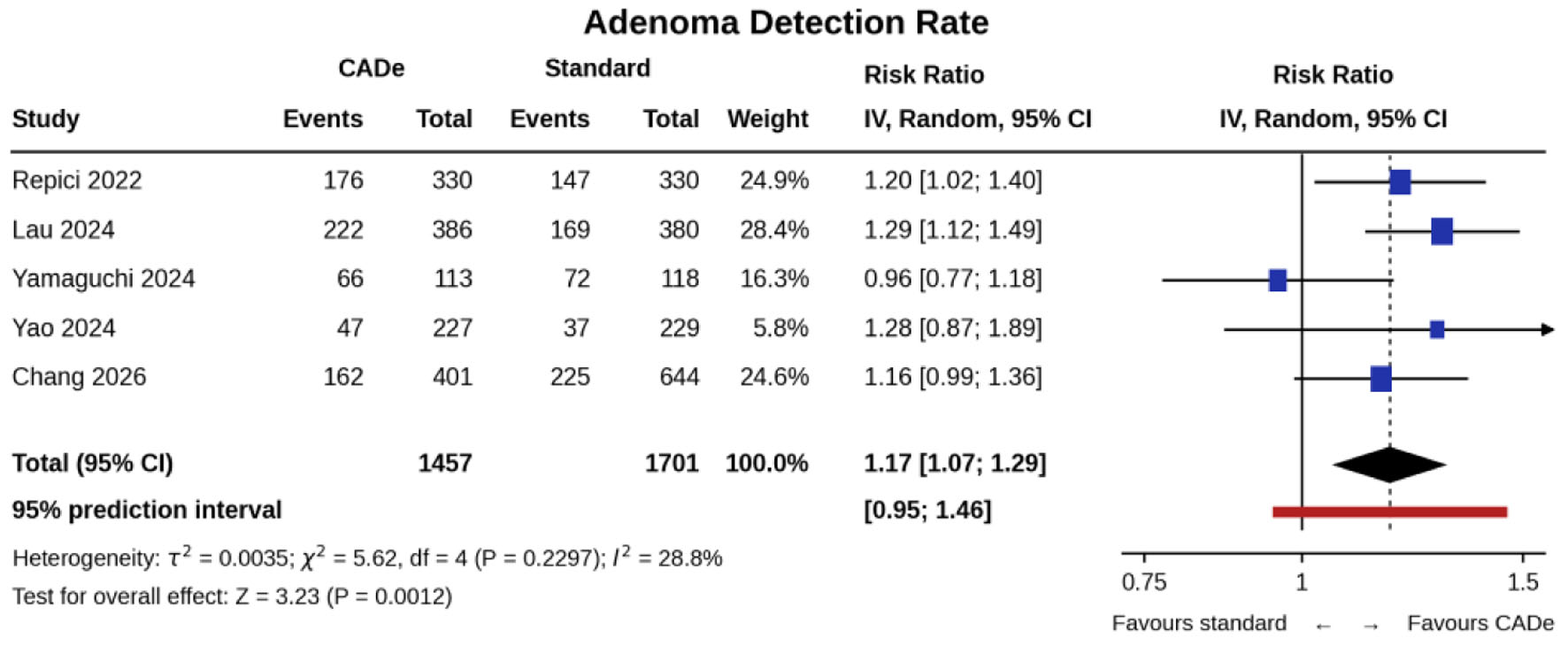
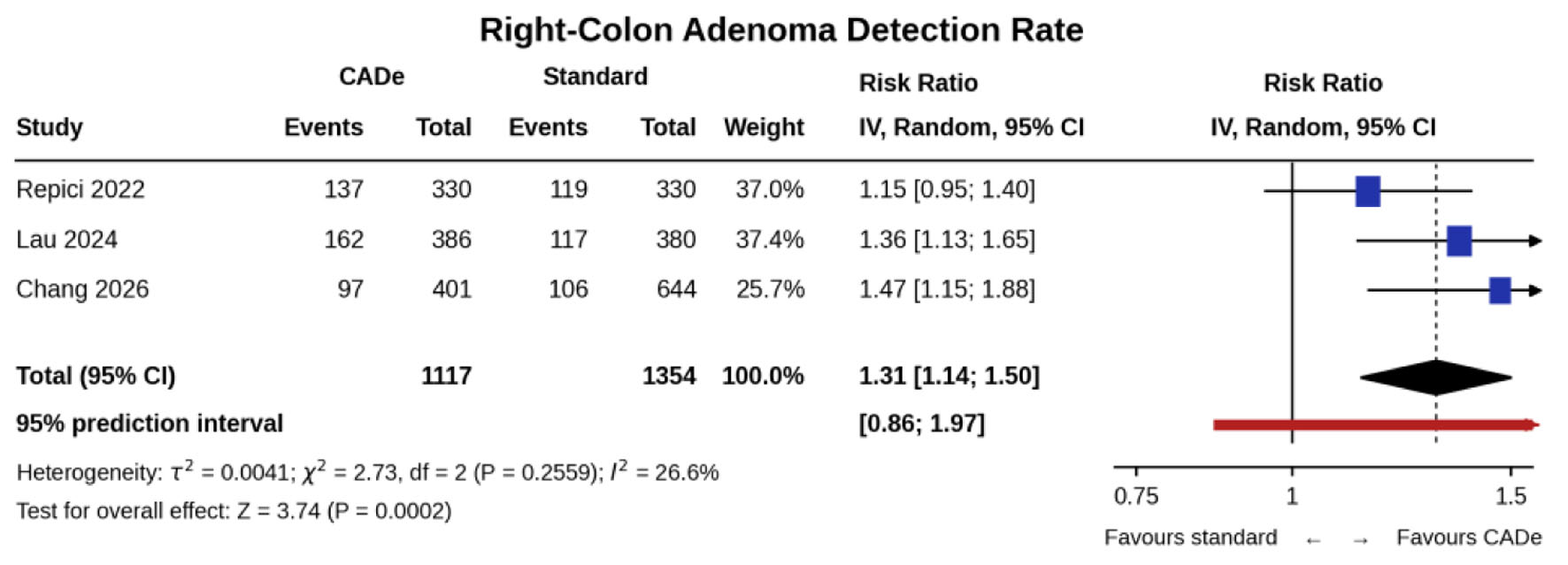
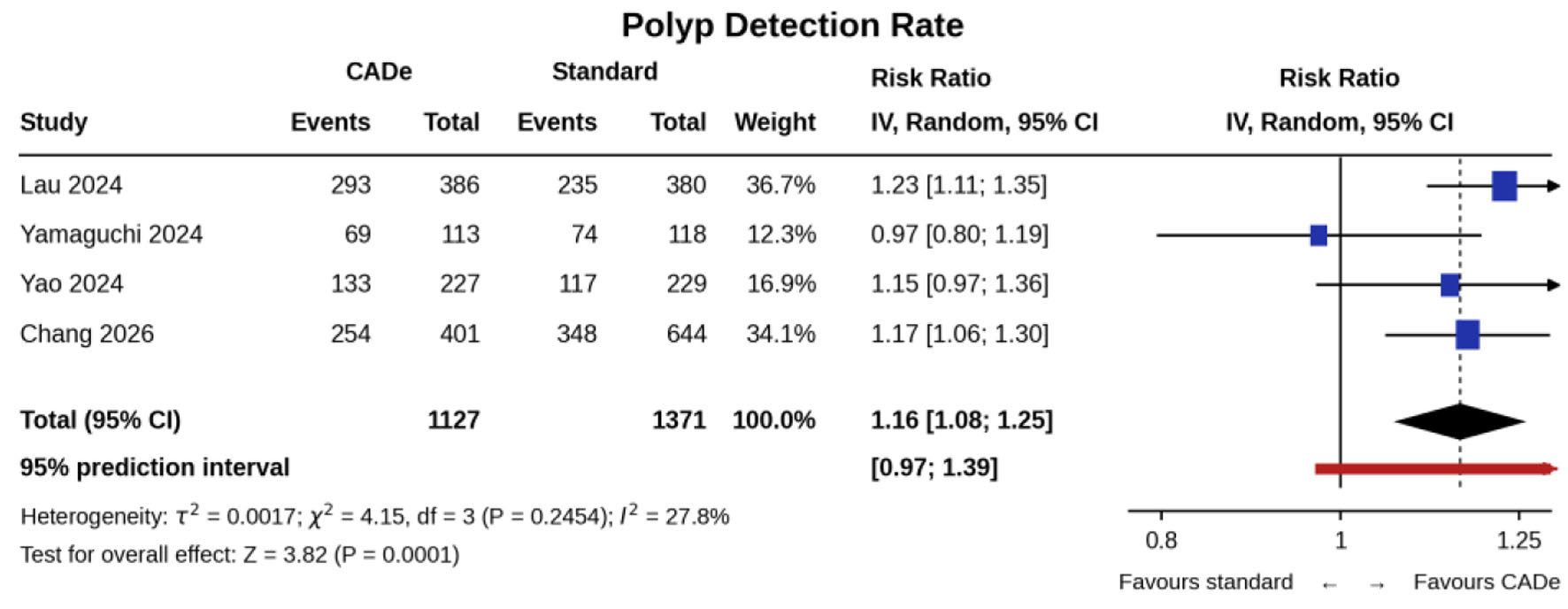
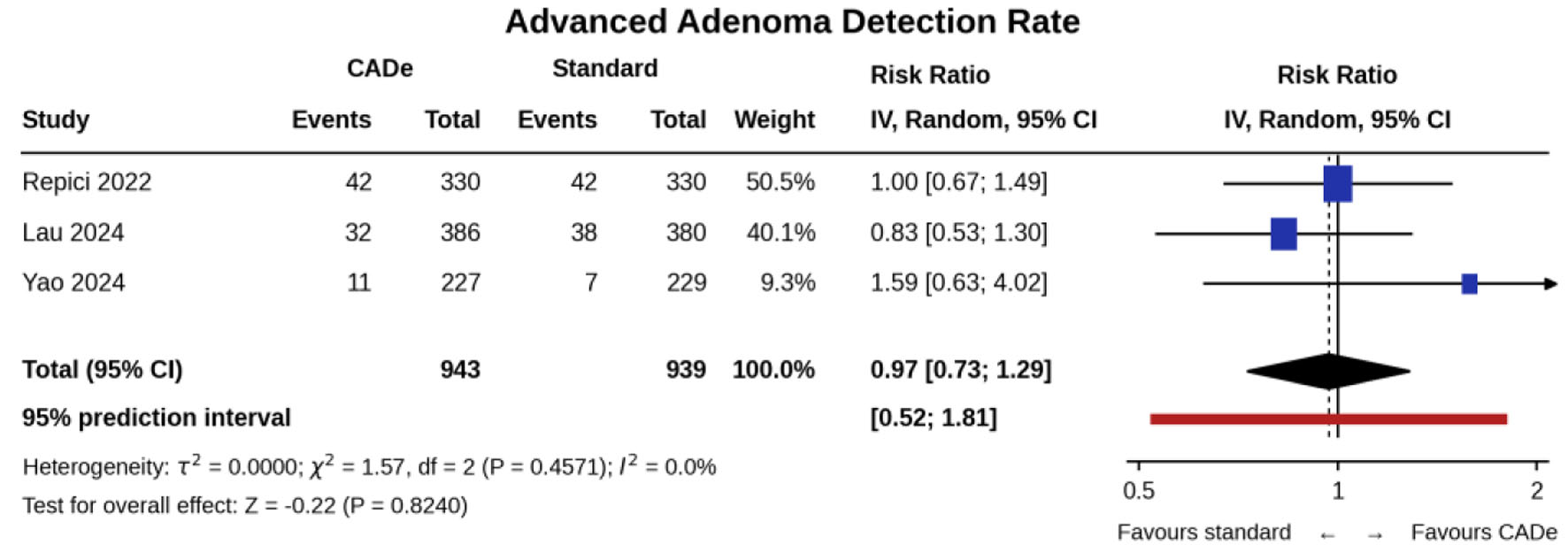
| Risk ratios and risk differences were pooled with DerSimonian–Laird random-effects models. Event counts and denominators for every trial are shown in Figures 2 to 5 and in Supplementary Material 3 (gr.elmerpub.com). Prediction intervals describe the range within which the true effect of a future comparable trial would be expected to lie. Hartung–Knapp confidence intervals are presented as a more conservative alternative to DerSimonian–Laird inference given the small number of trials. NNT is derived from the pooled risk difference and is reported only where that difference excluded zero (overall ADR 95% CI 9 to 37; right-colon ADR 95% CI 9 to 22; polyp detection rate 95% CI 7 to 27). Advanced adenoma detection rate values were revised during peer review to use the trainee-performed first pass counts reported by Yao 2024, for consistency with the extraction rule stated in Section “Outcomes”. ADR: adenoma detection rate; CI: confidence interval; NA: not applicable; NNT: number needed to treat; PI: prediction interval; RD: risk difference; RR: risk ratio. | ||||||||
| Overall ADR (primary) | 5 | 3,158 | 1.17 (1.07–1.29) | 0.0012 | 28.8 | 0.95–1.46 | 1.02–1.35 | +6.9% (+2.7 to +11.0); NNT 15 |
| Right-colon ADR | 3 | 2,471 | 1.31 (1.14–1.50) | 0.0002 | 26.6 | 0.86–1.97 | 0.96–1.77 | +8.2% (+4.6 to +11.7); NNT 12 |
| Polyp detection rate | 4 | 2,498 | 1.16 (1.08–1.25) | 0.0001 | 27.8 | 0.97–1.39 | 1.02–1.32 | +8.9% (+3.7 to +14.2); NNT 11 |
| Advanced adenoma detection rate | 3 | 1,882 | 0.97 (0.73–1.29) | 0.8240 | 0.0 | 0.52–1.81 | 0.56–1.68 | +0.2% (−2.2 to +2.6); NNT NA |
| Study | D1: Randomization process | D2: Deviations from intended interventions | D3: Missing outcome data | D4: Measurement of the outcome | D5: Selection of the reported result | Overall |
|---|---|---|---|---|---|---|
| Judgments in domain 2 reflect the fact that operator exposure to the CADe display cannot be blinded in any trial of this intervention. The domain 1 judgment for Chang 2026 reflects randomization at the level of the procedure room and fellow day rather than the individual patient. D: domain; RoB 2: Cochrane Risk of Bias 2 tool. | ||||||
| Repici 2022 [20] | Low | Some concerns | Low | Low | Some concerns | Some concerns |
| Lau 2024 [21] | Low | Low | Low | Low | Low | Low |
| Yamaguchi 2024 [23] | Low | Some concerns | Low | Low | Low | Some concerns |
| Yao 2024 [24] | Low | Some concerns | Low | Low | Low | Some concerns |
| Chang 2026 [22] | Some concerns | Some concerns | Low | Low | Low | Some concerns |
| Outcome (trials; patients) | Anticipated absolute effects | Relative effect (95% CI) | Certainty of evidence | Reasons for downgrading |
|---|---|---|---|---|
| All outcomes began as high-certainty evidence because all included studies were randomized controlled trials; (−1) and (−2) denote the number of levels by which certainty was downgraded in that domain. Doi plots and LFK indices were generated for all outcomes but are exploratory with three to five trials and were not used as a basis for downgrading. Certainty definitions: Moderate, the true effect is likely close to the estimate but may be substantially different; Low, the true effect may be substantially different from the estimate; Very low, the estimate is very uncertain. CADe: computer-aided detection; CI: confidence interval; GRADE: Grading of Recommendations, Assessment, Development and Evaluation; NNT: number needed to treat; RoB 2: Cochrane Risk of Bias 2 tool; RR: risk ratio. | ||||
| Overall adenoma detection rate (5 trials; 3,158 patients) | 38.2% with standard colonoscopy versus 46.2% with CADe; risk difference +6.9% (+2.7 to +11.0); NNT 15 | RR 1.17 (1.07–1.29) | Moderate | Risk of bias (−1): operator exposure to the CADe display cannot be blinded and 4 of 5 trials were rated at some concerns using RoB 2. Inconsistency, indirectness, and imprecision not serious; publication bias undetected. |
| Right-colon adenoma detection rate (3 trials; 2,471 patients) | 25.3% versus 35.5%; risk difference +8.2% (+4.6 to +11.7); NNT 12 | RR 1.31 (1.14–1.50) | Low | Risk of bias (−1): as above. Imprecision (−1): only 3 contributing trials, and the Hartung-Knapp confidence interval (0.96–1.77) crosses the null. Inconsistency and indirectness not serious; publication bias undetected. |
| Polyp detection rate (4 trials; 2,498 patients) | 56.5% versus 66.5%; risk difference +8.9% (+3.7 to +14.2); NNT 11 | RR 1.16 (1.08–1.25) | Low | Risk of bias (−1): as above. Indirectness (−1): polyp detection rate counts lesions of any histology rather than neoplasia, and CADe substantially increased the non-neoplastic resection rate in the single trial that measured it. Inconsistency and imprecision not serious; publication bias undetected. |
| Advanced adenoma detection rate (3 trials; 1,882 patients) | 9.3% versus 9.0%; risk difference +0.2% (−2.2 to +2.6) | RR 0.97 (0.73–1.29) | Very low | Risk of bias (−1): as above. Imprecision (−2): 3 trials contributing 172 events, with a confidence interval compatible with both appreciable benefit and appreciable harm. Inconsistency and indirectness not serious; publication bias undetected. |