| Gastroenterology Research, ISSN 1918-2805 print, 1918-2813 online, Open Access |
| Article copyright, the authors; Journal compilation copyright, Gastroenterol Res and Elmer Press Inc |
| Journal website https://gr.elmerpub.com |
Review
Volume 19, Number 4, August 2026, pages 175-183

Identifying Prognostic Factors Implicated in Chronic Functional Abdominal Pain in Children: A Systematic Review
Hannah Richardsona, c  , Ruth Blanda, Kirsty Grayb
aDepartment of Paediatrics, Queen Elizabeth University Hospital, Glasgow, UK
bCentre for Virus Research, University of Glasgow, Glasgow, UK
cCorresponding Author: Hannah Richardson, Department of Paediatrics, Queen Elizabeth University Hospital, Glasgow, UK
Manuscript submitted March 13, 2026, accepted June 24, 2026, published online August 26, 2026
Short title: Prognostic Factors Associated With Chronic FAP in Childhood
doi: https://doi.org/10.14740/gr2141
| Abstract | ▴Top |
Pediatric functional abdominal pain can place a significant burden on children and their families. Recent guidance has identified the benefits of hypnotherapy and cognitive behavioral therapy as management options; however, pharmacological approaches have only low certainty evidence. The aim of this study was to identify prognostic factors of chronic pain and risk of developing additional functional gastrointestinal disorders, among children with functional abdominal pain. Potential therapies could be targeted towards a population of children identified at higher risk of developing chronic abdominal pain. Relevant studies were identified through a search undertaken on four databases: Ovid MEDLINE, Embase, APA PsychInfo, and the Cochrane library, using a combination of MeSH terms and free text. Two independent reviewers screened results of this search utilizing set eligibility criteria, summarizing the characteristics of each included study according to a standardized table and assessing for risk of bias. Eight prospective cohort studies were included in the final review, with a range of duration of follow-up between 6 months to 15 years. Later age of onset of pain appeared to predict chronicity of pain, however not the development of an additional functional gastrointestinal disorder. The use of pain profiles, combining gastrointestinal and non-gastrointestinal symptoms with intensity of pain, appeared to be particularly useful for predicting later development of a functional gastrointestinal disorder. Comparison between the studies was limited due to the heterogeneity of the patient profiles, prognostic factors and outcomes that were assessed. Future research should be directed to larger, standardized studies to assess the wide range of prognostic factors which may play a significant role in chronic functional abdominal pain.
Keywords: Pediatric functional abdominal pain; Functional gastrointestinal disorder; Prognostic indicators; Psychosocial factors
| Introduction | ▴Top |
Functional abdominal pain (FAP) is a common condition in the pediatric population and can be a significant cause of anxiety among patients and families, as well as a major reason for school absence [1]. The estimated worldwide prevalence of FAP disorders is 11.7%, with no statistically significant difference demonstrated between the continents. There has consistently been an underrepresentation of studies conducted in Africa, with only two studies out of a total of 66 included in a recent meta-analysis [2].
The incidence is much higher amongst girls, and there is an association with psychosocial factors including depression, anxiety and traumatic life events [3, 4]. Most children experience resolution of their abdominal pain; however, a recent review demonstrated that 29.1% of children can develop chronic abdominal pain, persisting on average 5 years after initial diagnosis [5].
The pathogenesis of FAP remains unclear, and the diagnosis largely relies on the exclusion of other organic causes for the pain. This may be through history and examination alone, with a recent review demonstrating no improvement in prognosis when additional medical investigations were undertaken [5]. Since 1999, the ROME criteria were introduced to aid the diagnosis of functional gastrointestinal disorders (FGID) in children [6, 7]. Updated in 2016, the ROME IV defines functional abdominal pain–not otherwise specified (FAP-NOS) as chronic or episodic abdominal pain, not fully explained by an organic cause or meeting the criteria for another FGID. The pain must be present at least four times per month for at least 2 months prior to a diagnosis. Worldwide data regarding epidemiology of FAP disorders has utilized different ROME criteria for definition with resulting differences in prevalence (13.2% for ROME III compared to 9% for ROME IV) [2].
A recent review by the European and North American Societies for Pediatric Gastroenterology, Hepatology, and Nutrition has provided recommendations on pharmacological and non-pharmacological approaches to FAP and irritable bowel syndrome (IBS) based on the level of evidence available. Based on available evidence, the strongest recommendations were provided for hypnotherapy and cognitive behavioral therapy (CBT). Percutaneous electrical nerve field stimulation has also been recommended as a new emerging therapy. With regard to hypnotherapy, eight studies were included in the review, either comparing hypnotherapy with a control intervention or assessing the outcomes between the different forms of provision. Randomized controlled trials have shown a significant improvement in outcomes with hypnotherapy in pediatric patients compared to standard care, but that no specific treatment module is preferential (gut-directed, in-person, self-directed) and that any could be considered. Within the adult population, gut-directed hypnotherapy has been shown to have a notable effect on sensorimotor function and modulating brain-gut pain pathways and has been recommended for use in severe refractory FGID, while group CBT has been demonstrated to have significant benefit within patients with refractory IBS [8, 9].
As seen in prior reviews, there was limited evidence for pharmacological treatments; however, some can be considered on an individual patient basis, for example: multi-strain probiotics, enteric-coated peppermint capsules, amitriptyline, domperidone and cyproheptadine. The guidance highlights the importance of providing the patients with education regarding their diagnosis and advise caution with the use of dietary modifications or over-the-counter analgesia for chronic pain [10, 11].
The aim of this review is to identify factors which may predispose children with FAP to a higher risk of chronic abdominal pain, FGID or pain-related disability. In this way, treatments could be targeted to this cohort of children identified at risk, or to addressing the prognostic factors themselves.
| Methods | ▴Top |
Search strategy
A literature search was undertaken on April 19, 2024, using Ovid MEDLINE, Embase, APA PsychInfo, and the Cochrane library (Supplementary Material 1, gr.elmerpub.com). Searches were limited to the past 15 years and those published in the English language.
Following removal of duplicates, two independent authors utilized set eligibility criteria to select the studies for review and undertake data extraction. This review adhered to the Preferred Reporting Items for Systematic Reviews and Meta-Analyses (PRISMA) 2020 guidance.
Eligibility criteria
Inclusion criteria
The selected population group for this review were children up to the age of 19, with FAP of non-organic etiology. Studies were included if their outcomes included either persistence of the abdominal pain, pain-related disability or development of another FGID beyond 6 months.
Exclusion criteria
Specific exclusion criteria for this review included studies not published in English or those not involving human participants. Studies were excluded if they assessed response to any intervention out with standard symptom management, or if they assessed children with an organic disease. Unpublished studies, conference abstracts, case series and reports were excluded. Due to the likelihood of a difference between etiologies or prognostic factors for different FGIDs, studies focusing solely on functional dyspepsia, IBS or functional constipation were excluded.
Data extraction and assessment of bias
Two authors independently undertook data extraction and assessment of bias. Data were extracted using a standardized form, outlining the target population, number of participants, outcomes measured, authors’ conclusions and any limitations identified.
Risk of bias was assessed using the Newcastle-Ottawa Scale (NOS) for non-randomized cohort studies. Stars are awarded following set guidance with respect to three domains: selection, comparability, and outcome [12]. These are then converted to a previously agreed rating of poor, fair or good quality as per Agency for Healthcare Research and Quality (AHRQ). These were defined as follows: (1) good quality: three or four stars in selection domain, and one or two stars in comparability domain, and two or three stars in outcome/exposure domain; (2) fair quality: two stars in selection domain, and one or two stars in comparability domain, and two or three stars in outcome/exposure domain; (3) poor quality: zero or one star in selection domain, or zero stars in comparability domain, or zero or one star in outcome/exposure domain [13].
Where there was disagreement between results, particularly through use of the NOS for assessment of selection bias, opinion was sought from a third independent reviewer.
| Results | ▴Top |
The initial search identified 689 studies once duplicates were removed. The majority of these were removed by screening the title or abstract using eligibility criteria. Twenty-six articles were assessed in full and screened as follows: 11 conference abstracts were removed; one study was excluded as it was a follow-up on the comparison between the use of drotaverine versus placebo [14], and another was excluded because it compared the use of two different forms of behavioral therapy [15]. Four studies did not assess chronic pain or FGID beyond 6 months [16–19], and one study did not exclude children with an organic cause for their abdominal pain [20]. Eight studies were included in the final review (Fig. 1).
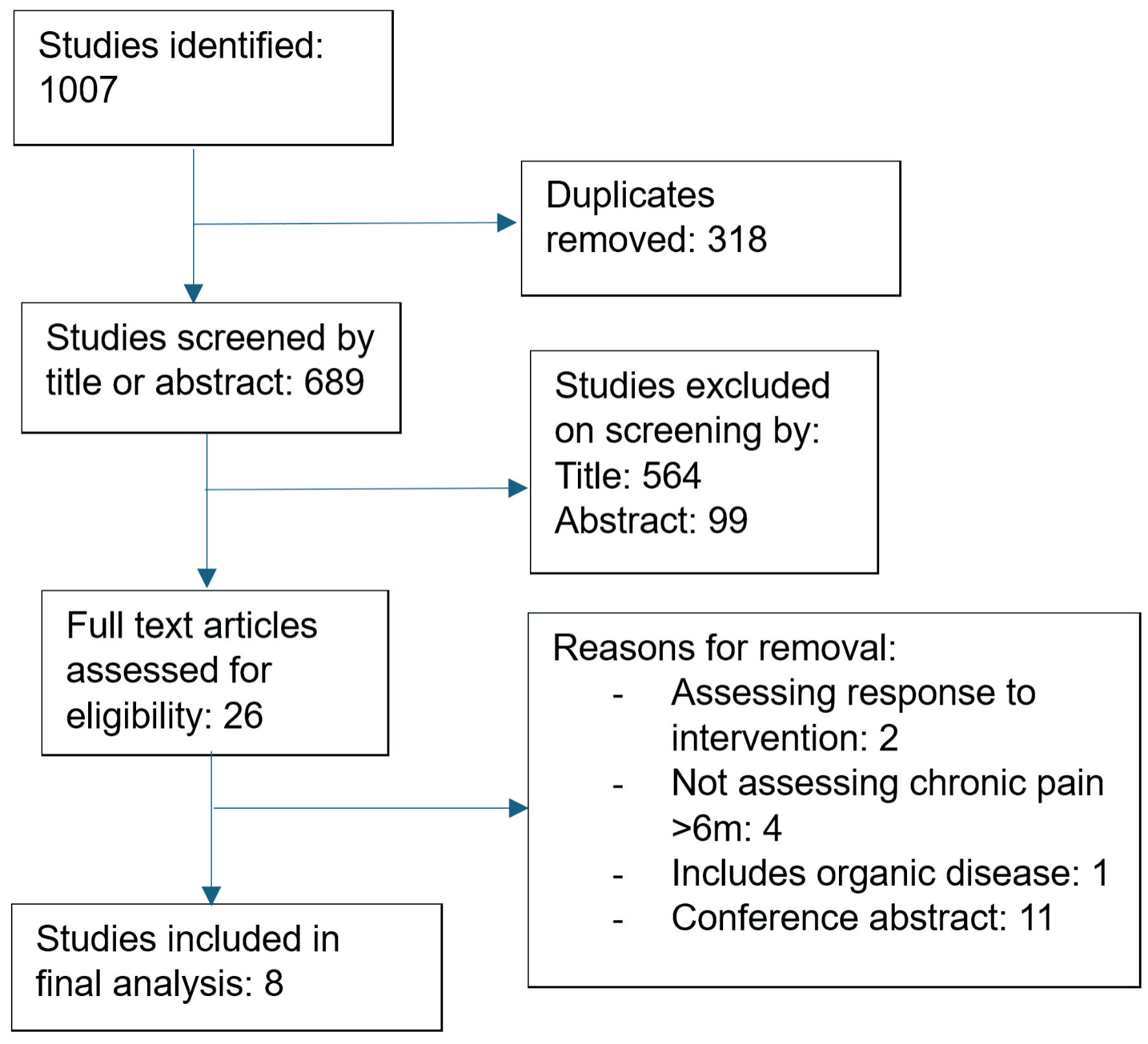 Click for large image | Figure 1. PRISMA flowchart. PRISMA: Preferred Reporting Items for Systematic Reviews and Meta-Analyses. |
Characteristics of included studies
The characteristics of the included studies are summarized in Table 1 [21–28]. All the studies were prospective cohort in nature.
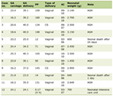 Click to view | Table 1. Characteristics of Included Studies |
Population
The studies varied greatly in terms of size of population, with the smallest study consisting of 64 participants and the largest population-based study assessing a total of 2,455 [21]. In all the studies, there was a higher proportion of females, in general between 60–70% of the cohort. Most of the studies recruited participants from tertiary gastroenterology services [22–26], with one study recruiting solely from primary care [27] and one study from a mixture of primary and tertiary services [9]. The majority of the studies recruited participants age 8 years and older to allow reliable self-report of symptoms. One study did not provide the exact age range; however, all the patients had been recruited from a pediatric gastroenterology department. This same study recruited their cohort based on ROME II criteria [24]. None of the other studies utilized ROME criteria to define FAP in their initial population selection, instead recurrent abdominal pain (RAP) was clearly defined by set criteria, ensuring to exclude children and adolescents with an organic cause for their symptoms.
Exposure
There was great heterogeneity between definitions of FAP utilized by the individual studies and the prognostic factors assessed. This made generalizability between results impossible. Only one study recruited their cohort based on ROME criteria, while the remainder defined RAP using set criteria. The range of prognostic factors included psychosocial and gastrointestinal features associated with the pain.
Outcome
The outcome for most of the studies was either chronic RAP, a diagnosis of an FGID, or pain-related disability. The shortest length of follow-up for outcomes was 6 months [23, 27] and the longest 15 years [21].
Risk of bias summary
Utilizing the NOS scale and appropriate AHRQ standards, most studies met the criteria for fair quality (Table 2) [21–28]. Three of the studies met the criteria for a poor standard and high risk of bias. There was a greater potential for attrition bias, with a large loss of cohort to follow-up with no clear explanation or description of demographics in this group [23]. For Czyzewski et al, there was a recognition that children with lower pain frequency were more likely to be lost to follow-up, impacting the generalizability of results [28]. The only study to meet a good quality standard was that by Sjolund et al, which differed from the other studies as it was a birth cohort study, therefore the outcome of interest was not present at the start [21]. Unlike the other studies, Bonilla et al [24] used ROME criteria to define their initial cohort, while a few of the studies used these criteria to identify their outcomes. There is a reasonable risk of reporting bias within the current systematic review: both from the 11 studies which had not been published in full text, as well as others that were potentially not found due to lack of publication. A request was made to the authors of the conference abstracts for access to the full paper; however, these did not receive a response.
Click to view | Table 2. Risk of Bias Assessment |
Results of individual studies
Several studies controlled for age and gender due to their potential effect as confounding factors. Two studies assessed the effect of age at initial development of abdominal pain on possible persistence of the pain. Sjolund et al [21] found that there was a significant association between RAP at 12 years and ongoing RAP at 16 years, whereas there was no association with early childhood colic age 1–2. There were no other points of follow-up assessed to clarify the relationship with age [21]. Helgeland et al found a significant association between older age at baseline of abdominal pain and higher level of pain and pain-related disability at follow-up 6 to 9 months later. They also found an association with female gender and higher levels of pain at follow-up; however, this was not statistically significant [27]. Horst et al did not find a significant association between age or gender as predictors of FGID later in life [25].
Cunningham et al found that there was a combined predictive effect between anxiety, pain intensity and functional disability at baseline with functional disability 6 months later; however, they found no significant association with one of these prognostic factors alone [23]. Another study did not find a significant association between anxiety and pain frequency at follow-up [28]. Horst et al identified depressive symptoms as a predictor of development of an FGID, in particular IBS and functional dyspepsia. Other independent prognostic factors identified were the severity of gastrointestinal symptoms and also the number of extra-intestinal somatic symptoms at baseline with presence of an FGID at follow-up 5 to 15 years later [25]. One study defined those with RAP as one of three profiles [26]. They found an association between those regarded as high pain dysfunctional (higher pain intensity, more gastrointestinal and non-gastrointestinal symptoms, increased levels of pain catastrophizing) with later development of an FGID.
Several studies identified gastrointestinal symptoms as predictors of later pain severity and development of an FGID, both as a measure of cumulative symptoms and the presence of individual symptoms such as nausea or pain–stooling relations alone [22, 25, 28].
Only one study assessed body mass index (BMI) as a potential factor in RAP. Bonilla et al found a significant association between obesity and frequency and intensity of pain at follow-up 12–15 months later [24].
| Discussion | ▴Top |
What this study adds
This review adds to the limited knowledge of prognostic factors associated with chronic FAP in childhood. Several potential factors have been identified: in particular older age at onset, psychosocial symptoms (e.g., anxiety or pain catastrophizing), as well as a range of gastrointestinal symptoms. A few studies highlighted the combined effect of several prognostic factors, when one factor alone is not significantly associated with outcome. One study attributed patient profiles to combine multiple gastrointestinal, non-gastrointestinal and psychological prognostic factors and demonstrated differing outcomes on FAP [26].
Areas of bias and potential limitations
All the studies in this review were prospective in nature, and generally there was a low loss to follow-up. This minimizes the potential for recall or attrition bias. They also cover a range in length of follow-up from 6 months to 15 years, therefore giving a broad spectrum for the outcome of RAP. There was a range in outcomes assessed between studies, including chronic abdominal pain, development of an FGID or pain-related disability. Some studies did use ROME criteria to define outcome. There were no identified competing interests in the process of this review.
As previously discussed in the literature, the conclusions drawn by this review are limited by the relatively low number of studies which met inclusion and exclusion criteria, the small size of the studies and their heterogenous nature in terms of exposure and outcomes measured [29]. Despite the availability of set ROME criteria for the definition of FAP, only one study utilized these criteria in their definition at recruitment, and they failed to use the most recent version [24]. Generally, the authors adopted pre-defined criteria for RAP and clearly stated these in their papers. Sjolund et al [21] encompassed parent-reported “colic” within the RAP category at age 1–2 years and did not specify what features met the criteria for the term colic, aside from parent-report. This was then compared to reported RAP at 12 years. These two measures are very subjective and not necessarily comparable.
Pain is a subjective measure for both exposure and outcome, and all the studies relied on self-report. This impacted the bias assessment in “outcome” for all but one of the studies, due to the nature of the pain measurement. Another aspect of the bias assessment affected by this was within the “selection” criteria, since the outcome of interest (abdominal pain) was present at the start of the study. This shifted most of the studies into the “fair” category and potentially highlights that an adapted form of the bias assessment could be required. With respect to this review, the exposure and outcomes identified did not require a scale of pain, rather its presence or absence, and therefore self-reporting was felt likely to be less significantly biased. Previous studies have demonstrated that patients do not tend to over-report their pain and that their reports of chronic pain remain relatively stable with little evidence of recall bias [30, 31].
Several of the studies recruited patients from tertiary gastroenterology clinics and this has the potential to influence the generalizability of the cohort to the general population of pediatric FAP. It is proposed that children requiring management under tertiary services may have more significant abdominal pain or health-related anxieties. A 2008 review, however, has previously demonstrated no significant difference in prognosis for RAP recruited from secondary or tertiary services [5].
Although all the studies considered confounding factors to some degree, very few of them assessed potential therapies the patients had received prior to follow-up, and this could have potentially significant effects on the outcome. One study found a significant association between BMI and prognosis of RAP [24]. None of the other studies considered this as a potential confounding factor, and a recent analysis has demonstrated no such association [2].
A particular limitation identified in this review was that three out of the eight studies assessed children from overlapping cohorts originally recruited in previous studies during the 1990s and 2000s [22, 25, 26]. There was also no discussion of the proportion of the original databases who were then recruited for these subsequent studies, nor the demographics of those not included.
Areas for future research
It has been highlighted that larger, more rigorous studies are required into this topic. In particular, the adoption of ROME IV criteria for recruitment and measurement of outcome would make comparison between studies much more reliable. Soon-to-be introduced, the ROME V criteria, aims to differentiate between research and clinical diagnostic criteria, in particular specifying thresholds and endpoints. Focus should be placed on the severity of pain at onset and follow-up through the use of comparable scales (e.g., the visual analogue scale). The use of a reliable change index helps identify a statistically significant difference [6, 32]. This review has implications in the management of childhood FAP, allowing the identification of a cohort of children at higher risk of chronic abdominal pain. Services and potential therapies can therefore be targeted at this population to modify psychosocial symptoms, including anxiety and pain catastrophizing.
As previously discussed, the evidence surrounding treatment of FAP is limited; however, non-pharmacological treatment approaches, particularly CBT and hypnotherapy, should be considered. Some pharmacological options may be considered on an individual basis. Popular strategies utilized by parents include dietary changes, particularly high-fiber diets or gluten and dairy exclusion. These have shown no statistically significant evidence of benefit and may cause harm through nutrient deficiencies. A diet low in fermentable oligosaccharides, disaccharides, monosaccharides and polyols has been shown to improve symptoms in IBS; however, there is a lack of evidence for this treatment in FAP [33]. Larger, more robust randomized controlled trials are required to quantify the benefit that these psychological and pharmacological approaches can provide.
| Conclusions | ▴Top |
This review demonstrates a link between gastrointestinal symptoms, psychosocial factors and later age of onset of pediatric FAP with persistence of symptoms. This may be through an interplay of a variety of different prognostic factors, rather than solely relying on one factor alone. There may be a greater number of prognostic factors yet to be identified, out with those assessed in the small selection of studies available. This review suggests that larger studies, utilizing ROME criteria, are required in this field in order to highlight a cohort of children and adolescents at highest risk of chronic pain and disability. Through identification of a specific high-risk profile in pediatric patients with FAP, thorough assessment and early non-pharmacological interventions may by directed appropriately to improve the poor outcomes in this group.
| Supplementary Material | ▴Top |
Suppl 1. Search strategy using Ovid MEDLINE, Embase, APA PsychInfo, and the Cochrane library.
Acknowledgments
The authors acknowledge the support of various staff at the University of Glasgow and Queen Elizabeth University Hospital.
Financial Disclosure
None to declare.
Conflict of Interest
This work was undertaken as part of a thesis for a Certificate in Child Health at the University of Glasgow. It was not registered with PROSPERO but adhered to the PRISMA 2020 guidelines.
Author Contributions
Hannah Richardson designed the study, conducted the literature review and analysis, and wrote the manuscript. Ruth Bland supervised the study, contributed to the study design, edited the manuscript, and acted as a third independent reviewer when discrepancies arose. Kirsty Gray independently conducted the literature review and data analysis.
Data Availability
The authors declare that data supporting the findings of this study are available within the article.
| References | ▴Top |
- Youssef NN, Atienza K, Langseder AL, Strauss RS. Chronic abdominal pain and depressive symptoms: analysis of the national longitudinal study of adolescent health. Clin Gastroenterol Hepatol. 2008;6(3):329-332.
doi pubmed - Vermeijden NK, de Silva L, Manathunga S, Spoolder D, Korterink J, Vlieger A, Rajindrajith S, et al. Epidemiology of pediatric functional abdominal pain disorders: a meta-analysis. Pediatrics. 2025;155(2):e2024067677.
doi pubmed - Korterink JJ, Diederen K, Benninga MA, Tabbers MM. Epidemiology of pediatric functional abdominal pain disorders: a meta-analysis. PLoS One. 2015;10(5):e0126982.
doi pubmed - Chitkara DK, van Tilburg MA, Blois-Martin N, Whitehead WE. Early life risk factors that contribute to irritable bowel syndrome in adults: a systematic review. Am J Gastroenterol. 2008;103(3):765-774; quiz 775.
doi pubmed - Gieteling MJ, Bierma-Zeinstra SM, Passchier J, Berger MY. Prognosis of chronic or recurrent abdominal pain in children. J Pediatr Gastroenterol Nutr. 2008;47(3):316-326.
doi pubmed - Rome Foundation. Accessed May 30, 2026. https://theromefoundation.org.
- Apley J, Naish N. Recurrent abdominal pains: a field survey of 1,000 school children. Arch Dis Child. 1958;33(168):165-170.
doi pubmed - Vasant DH, Whorwell PJ. Gut-focused hypnotherapy for Functional Gastrointestinal Disorders: Evidence-base, practical aspects, and the Manchester Protocol. Neurogastroenterol Motil. 2019;31(8):e13573.
doi pubmed - Goodoory VC, Khasawneh M, Thakur ER, Everitt HA, Gudleski GD, Lackner JM, Moss-Morris R, et al. Effect of brain-gut behavioral treatments on abdominal pain in irritable bowel syndrome: systematic review and network meta-analysis. Gastroenterology. 2024;167(5):934-943.e935.
doi pubmed - Rexwinkel R, de Bruijn CMA, Gordon M, Benninga MA, Tabbers MM. Pharmacologic treatment in functional abdominal pain disorders in children: a systematic review. Pediatrics. 2021;147(6):e2020042101.
doi pubmed - Groen J, Gordon M, Chogle A, Benninga M, Borlack R, Borrelli O, Darbari A, et al. ESPGHAN/NASPGHAN guidelines for treatment of irritable bowel syndrome and functional abdominal pain-not otherwise specified in children aged 4-18 years. J Pediatr Gastroenterol Nutr. 2025;81(2):442-471.
doi pubmed - Wells GA, Shea B, O’Connell D, Peterson J, Welch V, Losos J, et al. The Newcastle-Ottawa Scale (NOS) for assessing the quality of nonrandomised studies in meta-analyses. Accessed April 22, 2024. https://www.ohri.ca/programs/clinical_epidemiology/oxford.asp.
- Shamsrizi P, Gladstone BP, Carrara E, Luise D, Cona A, Bovo C, Tacconelli E. Variation of effect estimates in the analysis of mortality and length of hospital stay in patients with infections caused by bacteria-producing extended-spectrum beta-lactamases: a systematic review and meta-analysis. BMJ Open. 2020;10(1):e030266.
doi pubmed - Rawlley B, Shah D, Narang M, Pandey M. Long-term outcome of children with recurrent abdominal pain. Indian Pediatr. 2020;57(5):465-466.
pubmed - Calvano C, Warschburger P. Treatment for pediatric functional abdominal pain: an initial examination of reciprocal associations between pain, functional impairment, and parental distress. J Pediatr Psychol. 2022;47(4):483-496.
doi pubmed - Trivic I, Hojsak I. Initial diagnosis of functional gastrointestinal disorders in children increases a chance for resolution of symptoms. Pediatr Gastroenterol Hepatol Nutr. 2018;21(4):264-270.
doi pubmed - Madani S, Parikh S, Madani RS, Krasaelap A. Long-term study of children with ROME III functional gastrointestinal disorders managed symptomatically in a biopsychosocial model. Gastroenterology Res. 2017;10(2):84-91.
doi pubmed - Laird KT, Preacher KJ, Walker LS. Attachment and adjustment in adolescents and young adults with a history of pediatric functional abdominal pain. Clin J Pain. 2015;31(2):152-158.
doi pubmed - Langer SL, Romano JM, Levy RL, Walker LS, Whitehead WE. Catastrophizing and parental response to child symptom complaints. Child Health Care. 2009;38(3):169-184.
doi pubmed - Lisman-van Leeuwen Y, Spee LA, Benninga MA, Bierma-Zeinstra SM, Berger MY. Prognosis of abdominal pain in children in primary care—a prospective cohort study. Ann Fam Med. 2013;11(3):238-244.
doi pubmed - Sjolund J, Uusijarvi A, Tornkvist NT, Kull I, Bergstrom A, Alm J, Tornblom H, et al. Prevalence and progression of recurrent abdominal pain, from early childhood to adolescence. Clin Gastroenterol Hepatol. 2021;19(5):930-938.e938.
doi pubmed - Russell AC, Stone AL, Walker LS. Nausea in children with functional abdominal pain predicts poor health outcomes in young adulthood. Clin Gastroenterol Hepatol. 2017;15(5):706-711.
doi pubmed - Cunningham NR, Jagpal A, Peugh J, Farrell MK, Cohen MB, Mezoff AG, Lynch-Jordan A, et al. Risk categorization predicts disability in pain-associated functional gastrointestinal disorders after 6 months. J Pediatr Gastroenterol Nutr. 2017;64(5):685-690.
doi pubmed - Bonilla S, Wang D, Saps M. Obesity predicts persistence of pain in children with functional gastrointestinal disorders. Int J Obes (Lond). 2011;35(4):517-521.
doi pubmed - Horst S, Shelby G, Anderson J, Acra S, Polk DB, Saville BR, Garber J, et al. Predicting persistence of functional abdominal pain from childhood into young adulthood. Clin Gastroenterol Hepatol. 2014;12(12):2026-2032.
doi pubmed - Walker LS, Sherman AL, Bruehl S, Garber J, Smith CA. Functional abdominal pain patient subtypes in childhood predict functional gastrointestinal disorders with chronic pain and psychiatric comorbidities in adolescence and adulthood. Pain. 2012;153(9):1798-1806.
doi pubmed - Helgeland H, Van Roy B, Sandvik L, Markestad T, Kristensen H. Paediatric functional abdominal pain: significance of child and maternal health. A prospective study. Acta Paediatr. 2011;100(11):1461-1467.
doi pubmed - Czyzewski DI, Self MM, Williams AE, Weidler EM, Blatz AM, Shulman RJ. Maintenance of pain in children with functional abdominal pain. J Pediatr Gastroenterol Nutr. 2016;62(3):393-398.
doi pubmed - Zeevenhooven J, Timp ML, Singendonk MMJ, Benninga MA, Tabbers MM. Definitions of pediatric functional abdominal pain disorders and outcome measures: a systematic review. J Pediatr. 2019;212:52-59.e16.
doi pubmed - Boring BL, Ng BW, Nanavaty N, Mathur VA. Over-rating pain is overrated: a fundamental self-other bias in pain reporting behavior. J Pain. 2022;23(10):1779-1789.
doi pubmed - Landmark T, Romundstad P, Dale O, Borchgrevink PC, Kaasa S. Estimating the prevalence of chronic pain: validation of recall against longitudinal reporting (the HUNT pain study). Pain. 2012;153(7):1368-1373.
doi pubmed - Saps M, van Tilburg MA, Lavigne JV, Miranda A, Benninga MA, Taminiau JA, Di Lorenzo C. Recommendations for pharmacological clinical trials in children with irritable bowel syndrome: the Rome foundation pediatric subcommittee on clinical trials. Neurogastroenterol Motil. 2016;28(11):1619-1631.
doi pubmed - Andrews ET, Beattie RM, Tighe MP. Functional abdominal pain: what clinicians need to know. Arch Dis Child. 2020;105(10):938-944.
doi pubmed
This article is distributed under the terms of the Creative Commons Attribution 4.0 International License (CC BY 4.0), which permits unrestricted use, distribution, and reproduction in any medium, including commercial use, provided the original work is properly cited.
Gastroenterology Research is published by Elmer Press Inc.