

Socioeconomic Deprivation Does Not Influence Disease Severity or Access to Dupilumab in Eosinophilic Esophagitis
DOI:
https://doi.org/10.14740/gr2130Keywords:
Eosinophilic esophagitis, Dupilumab, Area deprivation indexAbstract
Background: Studies have explored the relationship between eosinophilic esophagitis (EoE) and various factors such as race, gender, and geographic elements, including urbanization, population density, and climate zones. However, the relationship between socioeconomic advantage or disadvantage and key pathology findings—particularly the esophageal peak eosinophil count at diagnosis, as well as access to biologic therapy—has not been extensively studied in pediatric EoE. This study aimed to examine these relationships to uncover potential influences.
Methods: This retrospective cohort study involved children aged 0 to 18 years evaluated in EoE clinic, including 16 patients who were refractory to other conventional therapies and ultimately treated with dupilumab. Details regarding eosinophil count per high power field (HPF) in the proximal and distal esophagus at the time of diagnosis were obtained from electronic medical records. Patients’ socioeconomic status was stratified using the Area Deprivation Index (ADI), which ranks neighborhoods based on socioeconomic disadvantage, calculated from the patients’ residential addresses. Data were analyzed using two-tailed t-test and multivariate regression analysis.
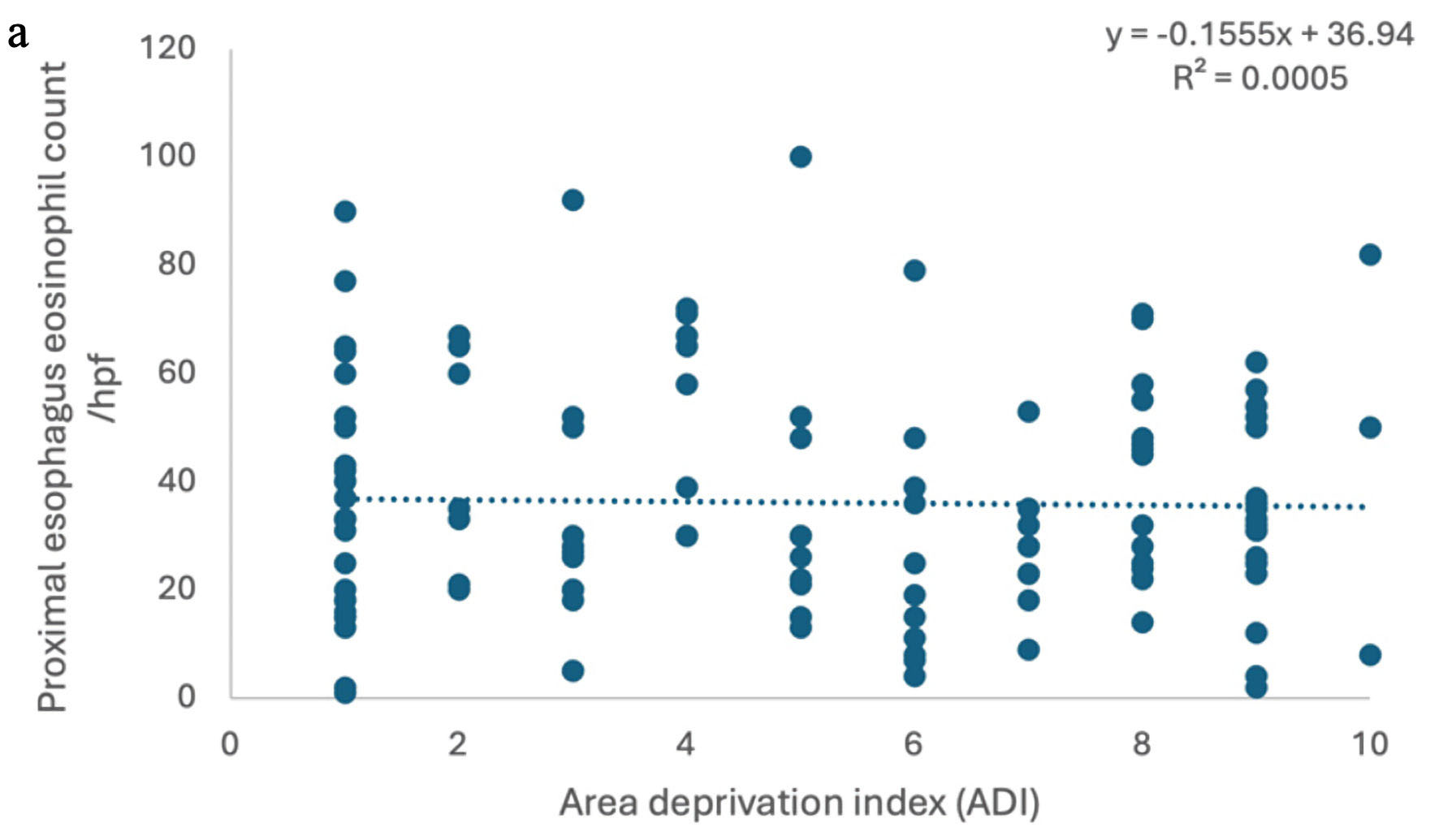
Results: A total of 145 pediatric patients were included in the study. The patient population was spread relatively evenly across the different levels of the ADI. Our analysis showed no significant correlation between ADI and eosinophil count in the distal and proximal esophagus. One hundred twenty-nine patients demonstrated significant histological response to conventional non-dupilumab therapies. In a subset of 16 patients receiving dupilumab, the analysis revealed no significant difference of ADI, and baseline eosinophil count at the diagnosis in the proximal and distal eosinophil count compared with the overall cohort. However, dupilumab treatment was associated with a significant reduction in eosinophil counts, suggesting improved histologic outcomes compared with non-dupilumab therapies.
Conclusions: This study examined the potential impact of socioeconomic disparities on pediatric patients with EoE, including those who were refractory to other previous therapies and ultimately treated with dupilumab. Our results suggest that socioeconomic deprivation, as measured by the ADI, is not associated with baseline histologic severity in pediatric EoE. Dupilumab demonstrated significant therapeutic benefit in patients who were refractory to other therapies, and access to dupilumab was not influenced by ADI.
Published
Issue
Section
License
Copyright (c) 2026 The authors

This work is licensed under a Creative Commons Attribution 4.0 International License.