| Gastroenterology Research, ISSN 1918-2805 print, 1918-2813 online, Open Access |
| Article copyright, the authors; Journal compilation copyright, Gastroenterol Res and Elmer Press Inc |
| Journal website https://gr.elmerpub.com |
Review
Volume 000, Number 000, October 2026, pages 000-000

Prescribe, Co-Manage, or Refer? A Practical Approach for Incretin-Based Obesity Therapy in Gastroenterology Practice
George Salema, f, Gael Haddadb, Averie Vardamanc, Khoi Langa, Steven R. Brantd, Mary Zoe Bakere
aDivision of Gastroenterology and Hepatology, Department of Medicine, University of Oklahoma Health Sciences Center, Oklahoma City, OK, USA
bFaculty of Medicine, University of Aleppo, Aleppo, Syria
cDepartment of Pharmacy, OU Health, Oklahoma City, OK, USA
dDivision of Gastroenterology and Hepatology, Department of Medicine, Rutgers Robert Wood Johnson Medical School, Rutgers, The State University of New Jersey, New Brunswick, NJ, USA
eDivision of Endocrinology, Department of Medicine, University of Oklahoma Health Sciences Center, Oklahoma City, OK, USA
fCorresponding Author: George Salem, Section of Digestive Diseases and Nutrition, Department of Internal Medicine, University of Oklahoma Health Sciences Center, Oklahoma City, OK 73104, USA
Manuscript submitted August 4, 2026, accepted September 28, 2026, published online October 26, 2026
Short title: Incretin Therapy in GI Practice
doi: https://doi.org/10.14740/gr2182
| Abstract | ▴Top |
Incretin-based therapies create opportunities for gastroenterology (GI) services to treat obesity, but drug efficacy does not determine prescribing responsibility. We propose a practical care-allocation framework. A targeted narrative synthesis of adult clinical studies, professional guidance, labeling, and service evaluations informed the framework. A supplementary evidence map distinguishes treatment evidence from implementation extrapolation; selection was non-systematic. GI-led prescribing, co-management, and referral are organized around patient preference, indication, complexity, existing care, prescriber competence, and follow-up capacity. Product-specific precautions are separated from proposed routing criteria. Advanced practice providers and clinical pharmacists can provide defined functions within authorized scopes, although non-GI service evidence does not establish equivalent GI outcomes. Essential safety functions are distinguished from desirable staffing. Safeguards address nutrition, advanced liver disease, behavioral health, medication continuity, and fragmentation; candidate measures address response, persistence, safety, access, and patient experience. Prepared GI services may provide incretin therapy without making prescribing obligatory in every practice. The proposed prescriber-accountable framework should complement existing care and undergo prospective evaluation.
Keywords: Obesity; Incretin-based therapy; Gastroenterology; Advanced practice providers; Clinical pharmacists; Multidisciplinary care
| Introduction | ▴Top |
Obesity is a chronic, relapsing disease with important consequences for digestive and liver health. Patients seen in gastroenterology clinics may have metabolic dysfunction-associated steatotic liver disease (MASLD), metabolic dysfunction-associated steatohepatitis (MASH), reflux, or inflammatory bowel disease (IBD) alongside obesity. Gastroenterologists therefore encounter obesity-related care needs even when another clinician prescribes treatment. The American Gastroenterological Association (AGA) has promoted multidisciplinary obesity care and published guidance on pharmacological treatment in adults [1, 2].
Semaglutide and tirzepatide have expanded treatment options through substantial weight reduction and, in selected trial populations, cardiovascular, hepatic, or sleep-related benefits [3–9]. These findings make obesity pharmacotherapy increasingly relevant to gastrointestinal (GI) practice. Prescribing, however, creates responsibilities beyond the initial order: patient selection, titration, adverse-effect management, diabetes-medication coordination, nutrition, access, procedure planning, and maintenance. Weight regain after discontinuation reinforces the need for longitudinal follow-up [10].
Recent reviews have described incretin therapies across digestive diseases and encouraged greater GI involvement in obesity care [11–13]. This review addresses a different practical question: how should prescribing, monitoring, and referral responsibilities be allocated for an individual patient? We propose three care pathways while distinguishing published treatment evidence from indirect service-delivery evidence and author judgment. The aim is to complement effective primary care, endocrinology, and obesity-medicine services, not to replace them.
| Methods | ▴Top |
This targeted, non-systematic narrative review addresses adult outpatient care, principally involving semaglutide and tirzepatide. The initial synthesis drew on selected PubMed/MEDLINE literature, professional guidance, and regulatory materials through August 2, 2026. Targeted verification of cited records and product labeling continued through September 23, 2026; these checks were not a new comprehensive literature search. Search concepts included obesity pharmacotherapy, glucagon-like peptide-1 (GLP-1) receptor agonists, dual glucose-dependent insulinotropic polypeptide (GIP)/GLP-1 receptor agonists, GI practice, advanced practice providers (APPs), clinical pharmacists, MASLD/MASH, IBD, gastric emptying, endoscopy, nutrition, cirrhosis, and treatment discontinuation. Selection was purposive: adult clinical trials and current labeling informed efficacy, eligibility, and precautions; GI cohorts informed disease-specific applicability; and guidance and non-GI service evaluations informed possible delivery approaches. Pediatric prescribing and investigational agents were outside the proposed clinic model. Mechanistic and preclinical findings were not used to infer clinical benefit from a care-delivery model. The review is not an exhaustive comparison of available formulations or doses.
No registered protocol, duplicate independent screening, pooled analysis, or formal risk-of-bias or certainty grading was used. A reproducible screening denominator is unavailable; screening counts have therefore not been reconstructed. Supplementary Material 1 (gr.elmerpub.com) maps selected influential sources by design, population, findings, and limitations rather than presenting an exhaustive inventory. The synthesis separates treatment or regulatory evidence, indirect implementation evidence or professional guidance, and author-proposed care-allocation criteria, staffing alternatives, monitoring arrangements, and outcome measures. These operational proposals were not developed through formal consensus and require prospective evaluation. Purposive selection and incomplete coverage limit reproducibility and may introduce selection bias.
| Why the Question Matters in Contemporary GI Practice | ▴Top |
Referral to primary care, endocrinology, or obesity medicine remains an appropriate and often effective care model. New therapeutic indications nevertheless create opportunities for appropriately prepared GI clinicians to participate directly. In STEP 1, semaglutide 2.4 mg produced mean weight loss of approximately 15% at 68 weeks; SURMOUNT-1 demonstrated weight loss exceeding 20% with the highest tirzepatide dose at 72 weeks [3, 4]. SELECT established cardiovascular benefit in a defined high-risk population, and tirzepatide improved obstructive sleep apnea in adults with obesity [5, 9]. ESSENCE and SYNERGY-NASH demonstrated histologic benefits in selected patients with MASH [6, 7]. Current US labeling includes semaglutide injection for noncirrhotic MASH with moderate-to-advanced fibrosis, consistent with stages F2-F3, under accelerated approval [8]. These results support treatment in eligible populations; none establish that GI-led delivery is superior to another prescribing model.
A hepatologist treating noncirrhotic MASH, an IBD clinician providing longitudinal care to a patient with obesity, or a bariatric endoscopist may be positioned to integrate pharmacotherapy with digestive-disease management. A procedure-focused clinician may instead provide the greatest value by identifying obesity-related risk and arranging follow-up elsewhere. Patient preference, continuity, clinical expertise, and available resources are more informative than specialty title alone.
A US survey obtained 304 complete responses from 747 invited GI and hepatology clinicians. Although 96% believed weight-loss medications could benefit patients with MASLD, 77% reported never or rarely prescribing them; 86% worked at a liver-transplant center [14]. The results identify training, confidence, and access barriers, but the practice mix and potential nonresponse bias limit generalization to community GI. The survey also predates resmetirom approval and should not be interpreted as a current census of prescribing or as validation of this framework.
| Why Gastroenterologists May Be Well Positioned to Prescribe | ▴Top |
GI clinicians routinely evaluate the symptom domains that can complicate incretin treatment, including nausea, vomiting, constipation, diarrhea, dyspepsia, reflux, abdominal pain, biliary disease, and motility disorders [13, 15, 16]. They also coordinate endoscopy and manage digestive diseases in which obesity treatment may be relevant. These skills provide a rationale for involvement, but they are not evidence that gastroenterologists necessarily achieve better weight, safety, or persistence outcomes than other clinicians.
Observational IBD studies report weight loss without a consistent increase in measured exacerbation outcomes among treated patients [17–19]. Selection of relatively stable patients, residual confounding, and limited follow-up constrain interpretation. These data support individualized consideration of obesity treatment, not treatment of IBD itself with incretin therapy. The treating GI clinician can help distinguish inflammatory activity, nutritional compromise, and medication intolerance.
GI expertise is particularly valuable in managing common adverse effects. Nausea, vomiting, diarrhea, constipation, dyspepsia, and abdominal discomfort are frequent, especially during dose escalation, but are usually mild to moderate and transient [3, 4, 15, 16]. Practical interventions include slower escalation, temporary dose reduction, smaller and lower-fat meals, hydration, fiber or osmotic laxatives when appropriate, and evaluation for alternative pathology when symptoms are severe or persistent [16]. A clinician familiar with these syndromes may prevent unnecessary discontinuation while avoiding the opposite error of attributing every new GI complaint to the medication.
| Why Prescribing Should Not Become Automatic in Every GI Clinic | ▴Top |
The argument for GI involvement should not be converted into an expectation that every gastroenterologist prescribes. Incretin-based therapy requires longitudinal care. The initiating clinician should know who will handle dose escalation, refill interruptions, prior authorization, shortages, acute vomiting, constipation, hypoglycemia risk, pregnancy planning, inadequate response, excessive weight loss, and discontinuation. A practice that cannot answer these questions before the first prescription is not prepared to own treatment.
Product-specific eligibility and safety checks precede allocation of a care pathway. Semaglutide and tirzepatide are contraindicated in patients with a personal or family history of medullary thyroid carcinoma, in patients with multiple endocrine neoplasia type 2, and after a serious hypersensitivity reaction to the relevant product. Use is not recommended in severe gastroparesis; this precaution is distinct from the listed contraindications [8, 20]. Insulin or sulfonylurea use requires an agreed glucose-monitoring and medication-adjustment plan; whether specialist co-management is needed depends on the treating team’s competence. For weight management, do not initiate treatment during pregnancy; semaglutide should be stopped at least 2 months before a planned pregnancy. Tirzepatide users relying on oral hormonal contraception should switch to a nonoral method or add a barrier method for 4 weeks after initiation and after each dose escalation [8, 20]. These are product-specific precautions, not evidence-derived thresholds for choosing a specialty.
Lean-mass loss is not synonymous with sarcopenia. In the SURMOUNT-1 substudy, 160 participants had evaluable dual-energy X-ray absorptiometry (DXA) measurements at baseline and follow-up (week 72 or early discontinuation); approximately one quarter of weight lost was lean mass in both the pooled tirzepatide and placebo groups [21]. DXA lean mass is not a direct measure of muscle strength or function. Sarcopenia assessment emphasizes low strength, with reduced muscle quantity or quality used for confirmation [22]. Older age, cirrhosis, low intake, active GI disease, prior malabsorptive surgery, and functional limitation warrant particular attention [23, 24].
We propose documenting recent weight trajectory, dietary intake, falls, mobility, and difficulty rising from a chair before treatment. In higher-risk patients, a brief sarcopenia screen and a repeatable measure such as handgrip strength or a chair-rise test can support follow-up [22]. Review intake and hydration at titration contacts; repeat the same functional measure after approximately 3 months, or earlier with deterioration. This interval is a pragmatic proposal, not a validated incretin-specific schedule. Routine DXA is not required for every patient. Individualize protein and energy goals, particularly in renal or liver disease, and pair nutrition support with feasible resistance activity [23, 24]. Persistent poor intake, new weakness, or falls should prompt nutritional assessment and reconsideration of escalation rather than pursuit of a weight target.
Finally, serious GI safety signals must be interpreted carefully. A meta-analysis of 55 randomized trials found increased cholelithiasis risk and probably increased gastroesophageal reflux risk, with little or no effect on the other assessed GI or biliary events [15]. These findings do not exclude rare harms or eliminate the need to evaluate individual symptoms. GLP-1 receptor agonists are associated with increased gallbladder and biliary disease risk, particularly at higher doses, longer duration, and in weight-loss trials [25]. Persistent vomiting, severe abdominal pain, dehydration, progressive early satiety, or signs of obstruction should prompt assessment rather than routine reassurance. The goal is neither to exaggerate rare harms nor to normalize symptoms that threaten nutrition or hydration.
| A Proposed Competency- and Infrastructure-Based Approach | ▴Top |
We propose four considerations before choosing GI-led treatment: an appropriate indication and informed preference; a competent, legally authorized prescriber; coverage of essential safety and follow-up functions; and patient needs that fall within the team’s capability. These are proposed operating principles, not validated eligibility criteria. A trained physician or APP may be the accountable prescriber within applicable scope-of-practice and credentialing rules. The important distinction is between reliable longitudinal care and an isolated prescription, not between professional titles.
Table 1 compares the three suggested care pathways. Table 2 separates proposed essential safety functions from desirable capabilities and feasible alternatives. Every patient needs clinical assessment, a responsible prescriber, a contact and titration plan, medication reconciliation, basic nutritional review, and an escalation route. A dedicated on-site APP, pharmacist, dietitian, or obesity clinic is not mandatory when equivalent functions can be delivered safely through existing staff or external services. Conversely, the absence of a dedicated team does not excuse unassigned symptom calls, unsafe dose changes, or failure to arrange needed assessment.
 Click to view | Table 1. Proposed Prescribe–Co-Manage–Refer Pathways |
Click to view | Table 2. Essential Safety Functions and Flexible Program Resources |
Obesity pharmacotherapy belongs within comprehensive assessment and continuing care [1, 2]. Formal obesity-medicine certification may strengthen expertise, but the proposed model does not require a particular certification. Focused education, supervised experience, appropriate protocols, and review of outcomes offer possible routes to competence; their sufficiency has not been validated specifically for GI-led incretin care.
| Roles of APPs and Clinical Pharmacists | ▴Top |
APPs, including nurse practitioners and physician assistants, may assess, prescribe, educate, follow patients, and adjust treatment within their training and authorized scope. In the proposed model, an APP may be the accountable prescriber rather than only an assistant to a physician. Preparation should match the assigned clinical responsibilities, with consultation and escalation available when needed. Protocols support, but do not replace, clinical judgment. This allocation of tasks is an implementation proposal, not evidence that one professional group provides superior outcomes.
Clinical pharmacists can contribute medication reconciliation, formulary navigation, device education, interaction review, and dose-transition support; prescribing or titration authority depends on local arrangements. Service evaluations in cardiology and primary care describe weight or glycemic improvements [26, 27]. In one primary care evaluation involving 120 patients with type 2 diabetes, optimization required an average of 6.5 pharmacist encounters per patient [27]. These reports illustrate the repeated contacts that medication management may require; they do not establish a staffing ratio or demonstrate superior outcomes, workload savings, or cost-effectiveness in GI clinics. Adaptation should be evaluated in GI populations, particularly when digestive symptoms or nutritional vulnerability complicate treatment.
The organizing principle is prescriber-accountable care. One named, appropriately authorized clinician should be responsible for the incretin treatment plan, with backup coverage and documented responsibilities for other team members. APP and pharmacist roles must comply with jurisdictional law and institutional credentialing. Smaller practices may use a community pharmacist, shared dietitian, remote consultation, or trained existing staff rather than employ every discipline on site. Staffing should match patient needs and ensure that essential functions are actually covered.
| The Prescribe–Co-Manage–Refer Framework | ▴Top |
GI-led prescribing
GI-led prescribing refers to treatment delivered within a gastroenterology service by a suitably trained, authorized prescriber, including a physician or APP. It may be reasonable when the patient has an appropriate indication, a longitudinal GI relationship, reliable follow-up, and needs within the team’s competence. Examples include obesity with MASLD, eligible noncirrhotic MASH, stable IBD with adequate nutrition and a separate obesity indication, or pharmacotherapy integrated with bariatric endoscopy. These are proposed routing examples, not trial-validated selection rules. The named prescriber coordinates initiation, titration, response, adverse effects, and maintenance.
GI-led care need not be physician-only or isolated from primary care. Trained APPs and pharmacists may provide repeated contacts and medication support; nutrition referral should be available when the initial assessment identifies risk. The patient’s primary care clinician should remain informed, and preventive care and non-GI comorbidities should not be displaced by a specialty obesity service.
Co-management
We suggest co-management when a treatment indication is present but a clinical domain exceeds the prescriber’s routine expertise. Examples include complex diabetes requiring insulin adjustment, advanced organ disease, persistent nonurgent GI symptoms, nutritional vulnerability, or behavioral health needs. The same diagnosis may be managed differently in clinics with different capabilities. The plan should specify who changes the incretin dose, who adjusts other medications, who reviews tests, and who responds to symptoms. A shared chart or a concise written care plan can support these responsibilities.
Persistent symptoms illustrate the value of defined roles: a GI or motility clinician can investigate diagnostic uncertainty while the incretin prescriber decides whether treatment should be held, reduced, or stopped. An APP may coordinate follow-up, a dietitian assess intake, and a pharmacist reconcile dose changes. Co-management should add necessary expertise rather than duplicate visits or create competing medication instructions.
Referral
Referral is appropriate when safe longitudinal treatment cannot be provided in the GI clinic or when an established clinician already offers effective obesity care. A contraindication or absent indication is not a reason to seek another prescriber for the same drug. Defer initiation while unexplained recurrent vomiting, marked early satiety, malnutrition, suspected restrictive or purging eating pathology, or pregnancy-related questions are evaluated. Severe abdominal pain, inability to maintain fluids, or suspected obstruction or pancreatitis requires urgent clinical assessment rather than an ordinary referral queue [8, 20]. A completed handoff should communicate the question, current medications, recent dose, and interim responsibilities.
Figure 1 and Table 1 summarize the proposed pathways and their safety gates. Patients may move between pathways as symptoms, metabolic complexity, access, or clinician availability change. Neither co-management nor referral is a lesser standard of care; the appropriate pathway is the one that maintains safe, coordinated follow-up.
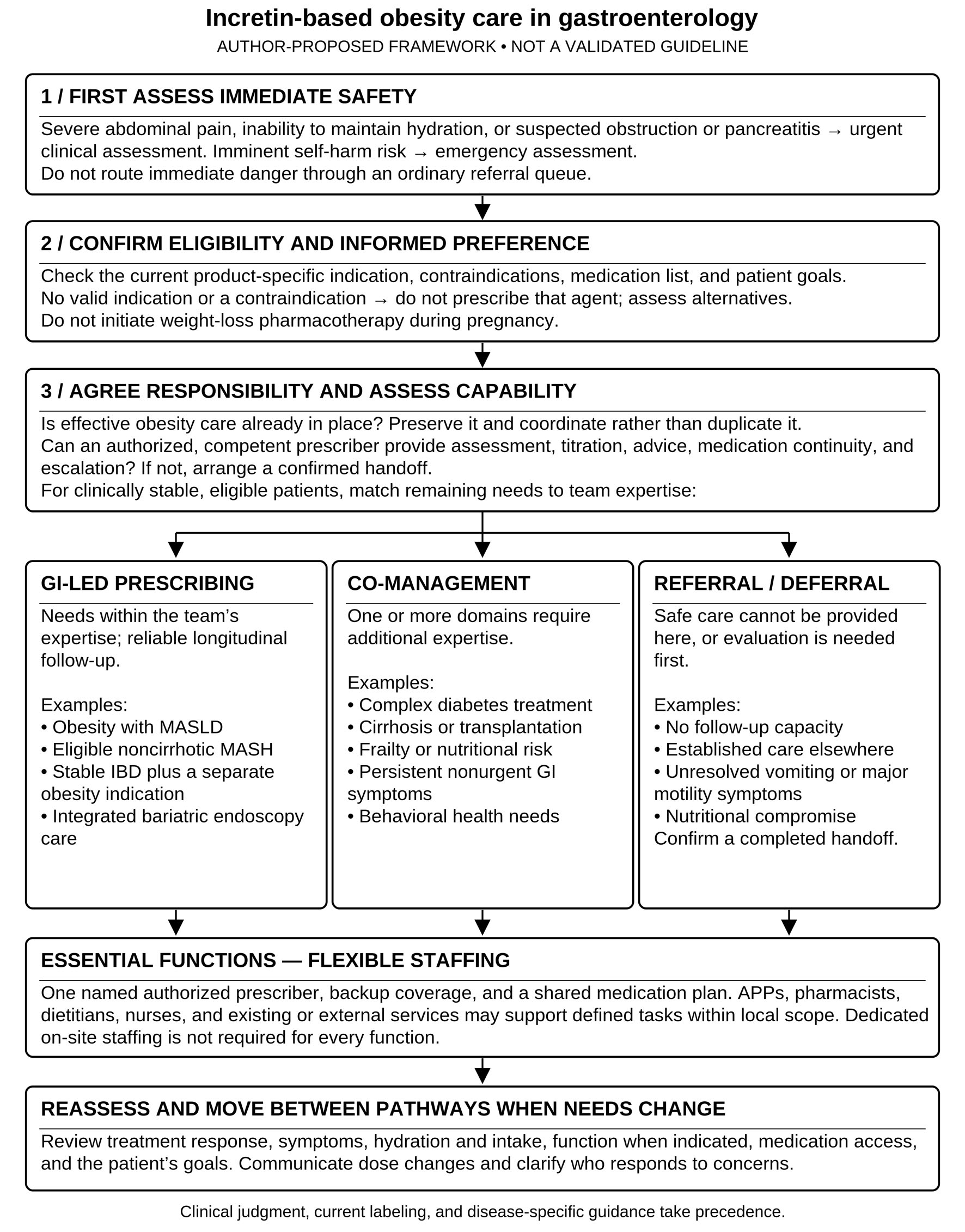 Click for large image | Figure 1. Proposed care-allocation algorithm for incretin-based obesity therapy in gastroenterology. Immediate safety concerns and product-specific eligibility are considered before choosing a care setting. Examples within each pathway are author-proposed routing considerations, not validated thresholds. Co-management depends on patient needs relative to clinician expertise. A trained physician or advanced practice provider may be the accountable prescriber when authorized; pharmacists and other professionals support defined functions within local scope. Severe symptoms require timely assessment rather than an ordinary referral queue. The framework supplements, and does not replace, labeling, disease-specific guidance, or clinical judgment. APP: advanced practice provider; GI: gastroenterology; IBD: inflammatory bowel disease; MASLD: metabolic dysfunction-associated steatotic liver disease; MASH: metabolic dysfunction-associated steatohepatitis. |
| Disease-Specific Considerations for Gastroenterology | ▴Top |
MASLD and MASH
The strongest liver-specific trial evidence comes from selected noncirrhotic MASH populations. ESSENCE demonstrated histologic benefit with semaglutide, and SYNERGY-NASH reported MASH resolution with tirzepatide [6, 7]. Current US labeling authorizes semaglutide injection for adults with noncirrhotic MASH and F2-F3 fibrosis under accelerated approval; it does not establish a MASH indication for every incretin agent or formulation [8, 20]. An obesity indication and a MASH indication should therefore be assessed separately. In a small Gastroenterology Research cohort, lower fibrosis-4 (FIB-4) values and liver enzymes were associated with GLP-1 therapy, but this uncontrolled change in surrogate markers does not establish histologic fibrosis regression [28].
Cirrhosis, nutritional vulnerability, and transplantation
Evidence in cirrhosis differs from that in noncirrhotic F2-F3 disease. In a 48-week randomized trial of 71 patients with compensated MASH-related cirrhosis, semaglutide did not significantly improve the primary fibrosis endpoint. No hepatic decompensation events or deaths were reported, but the small, selected population and limited duration do not establish safety in decompensated disease or transplant populations [29]. Compensated cirrhosis is therefore not interchangeable with the approved MASH population.
In decompensated cirrhosis, malnutrition, or sarcopenic obesity, our proposed default is hepatology-led multidisciplinary review rather than routine initiation in a general GI obesity pathway. Nutrition, functional reserve, and clinical stability take priority over a numerical weight goal. Ascites and edema can distort body weight and body-composition assessment; dry-weight estimates and repeated functional assessment are more informative than scale change alone [24]. A high body mass index does not exclude nutritional depletion. This is a cautious care-allocation proposal, not a claim that every cirrhotic patient has an absolute drug contraindication.
For transplant candidates, involve the transplant team before pursuing weight loss that could impair intake, functional status, or readiness for transplantation. For recipients, confirm graft stability, nutritional adequacy, diabetes therapy, and the immunosuppressive regimen. This review does not establish transplant-specific efficacy or safety. Current labeling cautions that delayed gastric emptying can affect oral medication absorption [8, 20]; any need for drug-level monitoring or immunosuppressant adjustment should be determined with the transplant team, not by an assumed class interaction or an automatic dose reduction. Prospective transplant-specific implementation evidence remains a priority.
IBD
In stable IBD, current observational evidence does not show a consistent increase in disease exacerbation, and weight loss appears comparable with non-IBD populations [17–19]. Nonetheless, baseline diarrhea, abdominal pain, nausea, poor intake, or recent inflammatory activity may complicate attribution of symptoms. Initiation is most straightforward when disease is objectively controlled and nutritional status is adequate. Persistent symptoms after treatment begins should not automatically be labeled an IBD flare or a drug effect without appropriate assessment. Stable IBD is not itself a labeled indication, and active disease with poor intake may warrant postponing weight-loss treatment while inflammation and nutrition are addressed.
Motility disorders and upper GI symptoms
Incretin therapies can delay gastric emptying and cause nausea, early satiety, or postprandial fullness [13]. Current semaglutide and tirzepatide labeling does not recommend use in severe gastroparesis [8, 20]. Mild dyspepsia should not automatically be equated with gastroparesis. Persistent vomiting, progressive nutritional compromise, or suspected obstruction warrants assessment before initiation or further escalation. GI expertise may appropriately lead to deferral or discontinuation, not simply more intensive prescribing.
Endoscopy and procedural care
The peri-endoscopic implications of GLP-1 therapy have generated uncertainty. AGA guidance and subsequent multisociety recommendations favor individualized risk assessment rather than universal medication cessation [30, 31]. Factors such as escalation phase, higher dose, weekly formulations, significant GI symptoms, and coexisting conditions that delay gastric emptying may increase concern. A recent meta-analysis in Gastroenterology Research found higher odds of retained gastric contents and procedure cancellation but no statistically clear increase in aspiration; this does not exclude a clinically important risk because estimates were imprecise [32]. The prescribing GI clinic should therefore coordinate with endoscopy and anesthesia teams, document the medication and dose-escalation phase, and apply local protocols consistently.
Behavioral health assessment
Ask about mood, anxiety, loss-of-control eating, restriction, purging, and whether weight goals are compatible with adequate nutrition. The Patient Health Questionnaire-9 (PHQ-9) and Generalized Anxiety Disorder-7 (GAD-7) can support assessment; scores of 10 or greater warrant clinical review but are not diagnoses or drug-exclusion thresholds [33, 34]. Stable treated depression or anxiety should not automatically preclude therapy. We propose behavioral health or eating-disorder consultation before initiation when clinically significant restrictive or purging behavior, diagnostic uncertainty, or impaired capacity to follow a safe nutritional plan is present. Suspected binge-eating disorder warrants assessment rather than a blanket prohibition. Any self-harm response or expressed suicidal thinking requires direct safety assessment; imminent risk requires emergency evaluation. Screening here addresses patient needs and safe care coordination, not an established causal effect of incretin drugs on suicidality. Integrating the plan with existing mental health care can avoid contradictory advice and unnecessary new referrals.
| Integration With Existing Care and Prevention of Fragmentation | ▴Top |
The proposed GI pathway borrows functions already used in multidisciplinary obesity care: shared decisions, pharmacotherapy, nutritional and behavioral support, follow-up, and procedural referral when appropriate [1, 2]. Primary care pathways can preserve a broad medical home; endocrinology-led services may be particularly useful for complex diabetes; and obesity-medicine programs can coordinate multiple weight-management options. GI-led care adds digestive-disease expertise when this addresses a genuine gap. These are functional comparisons, not evidence of comparative superiority, and local services frequently overlap.
Expansion into specialty practice may also produce duplicate visits or testing, conflicting prescriptions, unclear symptom responsibility, and higher costs. We propose asking who currently manages obesity before initiating therapy, obtaining the patient’s preference for coordination, and sharing one medication and monitoring plan with primary care. Dose changes should be communicated promptly, and clinically useful existing laboratory results should not be repeated simply because care moved between clinics. Where established care is working, GI consultation may be more appropriate than transfer of prescribing. Shared decisions should include nonpharmacologic and procedural options, affordability, and the option not to initiate medication. The aim is treatment of health-relevant obesity, not a prescription for every elevated body mass index or displacement of behavioral and social support. Whether these safeguards reduce fragmentation or spending remains untested.
| Operationalizing a GI Prescribing Pathway | ▴Top |
A small practice may start with patients whose needs are within its existing expertise, a limited formulary, and a written follow-up pathway. Document the indication, treatment goals, relevant medications, GI symptom baseline, nutritional risk, reproductive considerations, current obesity clinician, and the prescriber accepting responsibility. Provide written guidance on expected symptoms, alarm features, hydration, contact arrangements, and what to do when medication is unavailable.
Allocate tasks explicitly rather than assume that additional personnel are available. An authorized physician or APP may assess and prescribe; a trained nurse or pharmacist may provide education and triage within scope; administrative staff may coordinate authorization; and external nutrition services may accept higher-risk patients. Protocols should define which actions are delegated and which require prescriber review. A reliable handoff and backup contact are more important than a particular clinic title.
Assess tolerability before each dose increase and follow the current product- and indication-specific schedule. Delayed escalation or an appropriate lower labeled maintenance dose may be preferable to escalating through persistent symptoms [8, 20]. Avoid duplicate semaglutide or tirzepatide products and overlapping treatment with another GLP-1 receptor agonist [8, 20]. After an interruption, confirm the product, last dose, time off treatment, symptoms, and other glucose-lowering medications. Apply product-specific missed-dose and reinitiation instructions where available; interruptions not explicitly covered require an individualized prescriber plan rather than automatic resumption of the previous dose. A service-level supply-gap definition is not a restart-dose instruction. Review weight trajectory, intake, hydration, bowel symptoms, function when indicated, affordability, and patient goals. Apparent nonresponse warrants assessment of adherence, dose exposure, interruptions, competing medications, and alternative treatments rather than indefinite continuation without reassessment.
Long-term planning should be discussed at initiation. In the STEP 1 extension, participants regained approximately two thirds of prior weight loss within one year after semaglutide and the trial lifestyle intervention were discontinued, and cardiometabolic improvements moved toward baseline [10]. This does not mean every patient must remain on the same drug indefinitely, but it does mean that short-term prescribing without a maintenance strategy is incomplete care. Insurance loss, adverse effects, inadequate response, or patient preference may require transition to another medication, bariatric endoscopy, metabolic surgery, or intensified lifestyle treatment.
For local evaluation, we propose assessing at least 5%, 10%, and 15% weight-loss achievement at 6 and 12 months, together with the distribution of weight change. The relevant denominator comprises initiators who have had sufficient calendar time to reach each assessment; report observed follow-up and missing outcomes explicitly. Define same-agent and class-level persistence, switching, planned holds, and supply gaps before collecting data. Record urgent healthcare use and its clinically assessed relationship to treatment, nutritional and functional complications, liver-related outcomes when indicated, and patient experience. Lower FIB-4 should not be equated with fibrosis regression. Supplementary Material 2 (gr.elmerpub.com) supplies candidate definitions and denominators, not validated quality standards or mandatory weight targets. Comparisons across pathways must account for differences in baseline complexity and access; raw outcome rankings could penalize clinics managing the highest-risk patients.
| Access, Equity, and the Risk of Creating a Two-Tier Model | ▴Top |
High cost, insurance restrictions, and uneven access can limit treatment even when a prescriber is available [35]. We propose documenting denial reasons, supporting medically appropriate appeals, and discussing covered alternatives without misrepresenting an indication. Assess transport, food insecurity, language needs, digital access, and out-of-pocket burden. Rural practices may use shared pharmacists or dietitians and remote follow-up when feasible; telephone or local in-person alternatives remain important when broadband, devices, reimbursement, or licensure limit telehealth. Requiring every discipline on site would risk excluding precisely the clinics the framework is intended to support.
The division of tasks must be adapted to local APP and pharmacist authority, institutional credentialing, and reimbursement. US roles and insurance workflows should not be assumed to apply elsewhere. The World Health Organization’s conditional recommendations place GLP-1-based obesity treatment within comprehensive long-term care and emphasize affordability, equity, and health-system capacity [36]. International adaptation should preserve safety functions while using locally available professions, licensed products, and referral routes. For externally obtained products, reconcile the actual agent, formulation, concentration, and other incretin prescriptions; counseling about uncertainty and adverse effects should remain accessible even when the clinic is not the prescriber.
| Education and Future Directions | ▴Top |
Education should cover chronic obesity care, product-specific indications, titration, nutrition, common GI adverse effects, procedural coordination, and referral. APP and pharmacist training should reflect assigned functions and local authority. Prospective service evaluations could compare GI-led, co-managed, and referral pathways using consistent eligibility definitions, follow-up windows, and outcome ascertainment. Baseline disease severity, diabetes treatment, nutritional risk, access, and clinician selection require consideration to limit confounding. Persistence, clinical and nutritional safety, patient experience, utilization, and costs are more informative than prescription volume alone.
Several limitations are central to interpretation. Literature selection was non-systematic and did not generate a reproducible screening denominator or formal certainty assessment. Much of the treatment evidence comes from selected trial populations, whereas GI-specific service-delivery evidence is limited. The framework was not developed by a Delphi panel, validated against patient outcomes, or evaluated for cost-effectiveness. Proposed staffing alternatives, referral triggers, and monitoring intervals reflect author judgment and may perform differently across practices. US labeling and workforce arrangements limit direct international portability. Prospective studies and input from patients, community practices, primary care, and other disciplines are needed before the model can be treated as an established standard.
| Conclusion | ▴Top |
Incretin-based obesity therapy can be incorporated into GI care when a competent prescriber and reliable follow-up pathway are available. This does not require every gastroenterologist to prescribe or every practice to employ a dedicated multidisciplinary team. The proposed prescribe-co-manage-refer approach emphasizes patient preference, clinical complexity, essential safety functions, and a named accountable prescriber. APPs and clinical pharmacists can make important contributions within their training and scope, while external services can support smaller practices. Evidence supports selected drug indications and precautions; it does not yet establish the best specialty or service-delivery model. The framework should therefore be used as a practical proposal for adaptation and evaluation, while preserving effective existing care relationships.
| Supplementary Material | ▴Top |
Suppl 1. Selected evidence and its relationship to the proposed framework.
Suppl 2. Candidate measures for evaluating a GI incretin pathway.
Acknowledgments
None to declare.
Financial Disclosure
No external funding was received for this work.
Conflict of Interest
George Salem: consultant for AbbVie, Johnson and Johnson, Takeda, BMS, Pfizer, Eli Lilly, Celltrion.
Informed Consent
Not applicable. This narrative review reports no individual patient information.
Author Contributions
George Salem conceived the manuscript and drafted the initial framework. George Salem, Gael Haddad, Averie Vardaman, and Khoi Lang reviewed clinical and pharmacologic literature and developed recommendations. Steven R. Brant and Mary Zoe Baker provided senior supervision and critical revision. All authors critically revised the manuscript, approved the final version, and accept accountability for the work.
Data Availability
No original dataset was generated or analyzed. The evidence map identifies published sources supporting this narrative review; inquiries may be directed to the corresponding author.
AI Use Declaration
ChatGPT (OpenAI) assisted with language refinement, literature-source identification, and final edits. The authors take responsibility for source verification, clinical interpretation, and approval of the final manuscript. AI tools are not listed as authors.
Abbreviations
AGA: American Gastroenterological Association; APP: advanced practice provider; DXA: dual-energy X-ray absorptiometry; FIB-4: fibrosis-4 index; GAD-7: Generalized Anxiety Disorder-7; GI: gastrointestinal or gastroenterology; GIP: glucose-dependent insulinotropic polypeptide; GLP-1: glucagon-like peptide-1; IBD: inflammatory bowel disease; MASLD: metabolic dysfunction-associated steatotic liver disease; MASH: metabolic dysfunction-associated steatohepatitis; PHQ-9: Patient Health Questionnaire-9
| References | ▴Top |
- Grunvald E, Shah R, Hernaez R, Chandar AK, Pickett-Blakely O, Teigen LM, Harindhanavudhi T, et al. AGA clinical practice guideline on pharmacological interventions for adults with obesity. Gastroenterology. 2022;163(5):1198-1225.
doi pubmed - Acosta A, Streett S, Kroh MD, Cheskin LJ, Saunders KH, Kurian M, Schofield M, et al. White paper AGA: POWER - practice guide on obesity and weight management, education, and resources. Clin Gastroenterol Hepatol. 2017;15(5):631-649.10.
doi pubmed - Wilding JPH, Batterham RL, Calanna S, Davies M, Van Gaal LF, Lingvay I, McGowan BM, et al. Once-weekly semaglutide in adults with overweight or obesity. N Engl J Med. 2021;384(11):989-1002.
doi pubmed - Jastreboff AM, Aronne LJ, Ahmad NN, Wharton S, Connery L, Alves B, Kiyosue A, et al. Tirzepatide once weekly for the treatment of obesity. N Engl J Med. 2022;387(3):205-216.
doi pubmed - Lincoff AM, Brown-Frandsen K, Colhoun HM, Deanfield J, Emerson SS, Esbjerg S, Hardt-Lindberg S, et al. Semaglutide and cardiovascular outcomes in obesity without diabetes. N Engl J Med. 2023;389(24):2221-2232.
doi pubmed - Sanyal AJ, Newsome PN, Kliers I, Ostergaard LH, Long MT, Kjaer MS, Cali AMG, et al. Phase 3 trial of semaglutide in metabolic dysfunction-associated steatohepatitis. N Engl J Med. 2025;392(21):2089-2099.
doi pubmed - Loomba R, Hartman ML, Lawitz EJ, Vuppalanchi R, Boursier J, Bugianesi E, Yoneda M, et al. Tirzepatide for metabolic dysfunction-associated steatohepatitis with liver fibrosis. N Engl J Med. 2024;391(4):299-310.
doi pubmed - Novo Nordisk Inc. Wegovy (semaglutide) injection and tablets: US prescribing information. Revised June 2026. https://www.novo-pi.com/wegovy.pdf. Accessed September 23, 2026.
- Malhotra A, Grunstein RR, Fietze I, Weaver TE, Redline S, Azarbarzin A, Sands SA, et al. Tirzepatide for the treatment of obstructive sleep apnea and obesity. N Engl J Med. 2024;391(13):1193-1205.
doi pubmed - Wilding JPH, Batterham RL, Davies M, Van Gaal LF, Kandler K, Konakli K, Lingvay I, et al. Weight regain and cardiometabolic effects after withdrawal of semaglutide: The STEP 1 trial extension. Diabetes Obes Metab. 2022;24(8):1553-1564.
doi pubmed - Gold SL, Kornbluth A. The role of the gastroenterologist in obesity management: now is the right time for our involvement. Am J Gastroenterol. 2024;119(6):1001-1006.
doi pubmed - Pomenti S, Gerber A, Katzka D, Camilleri M, Hur C. Review article: the evolving role of GLP-1 receptor agonists in gastroenterology practice. Aliment Pharmacol Ther. 2026;63(2):203-209.
doi pubmed - Camilleri M, Lupianez-Merly C. Effects of GLP-1 and other gut hormone receptors on the gastrointestinal tract and implications in clinical practice. Am J Gastroenterol. 2024;119(6):1028-1037.
doi pubmed - Im GY, Asgharpour A, Aby ES, Stine JG, Mellinger JL, Luther J, Izzy M, et al. Medications for Weight Loss and MASLD: A National survey of hepatology and gastroenterology provider practices, attitudes, and knowledge before resmetirom. J Clin Gastroenterol. 2026;60(8):750-757.
doi pubmed - Chiang CH, Jaroenlapnopparat A, Colak SC, Yu CC, Xanthavanij N, Wang TH, See XY, et al. Glucagon-like peptide-1 receptor agonists and gastrointestinal adverse events: a systematic review and meta-analysis. Gastroenterology. 2025;169(6):1268-1281.
doi pubmed - Gorgojo-Martinez JJ, Mezquita-Raya P, Carretero-Gomez J, Castro A, Cebrian-Cuenca A, de Torres-Sanchez A, Garcia-de-Lucas MD, et al. Clinical recommendations to manage gastrointestinal adverse events in patients treated with Glp-1 receptor agonists: a multidisciplinary expert consensus. J Clin Med. 2022;12(1):145.
doi pubmed - Desai A, Khataniar H, Hashash JG, Farraye FA, Regueiro M, Kochhar GS. Effectiveness and safety of semaglutide for weight loss in patients with inflammatory bowel disease and obesity. Inflamm Bowel Dis. 2025;31(3):696-705.
doi pubmed - Levine I, Sekhri S, Schreiber-Stainthorp W, Locke B, Delau O, Elhawary M, Pandit K, et al. GLP-1 receptor agonists confer no increased rates of IBD exacerbation among patients with IBD. Inflamm Bowel Dis. 2025;31(2):467-475.
doi pubmed - Anderson SR, Ayoub M, Coats S, McHenry S, Tan T, Deepak P. Safety and effectiveness of glucagon-like peptide-1 receptor agonists in inflammatory bowel disease. Am J Gastroenterol. 2025;120(5):1152-1155.
doi pubmed - Eli Lilly and Company. Zepbound (tirzepatide) injection: US prescribing information. https://pi.lilly.com/us/zepbound-uspi.pdf. Accessed September 23, 2026.
- Look M, Dunn JP, Kushner RF, Cao D, Harris C, Gibble TH, Stefanski A, et al. Body composition changes during weight reduction with tirzepatide in the SURMOUNT-1 study of adults with obesity or overweight. Diabetes Obes Metab. 2025;27(5):2720-2729.
doi pubmed - Cruz-Jentoft AJ, Bahat G, Bauer J, Boirie Y, Bruyere O, Cederholm T, Cooper C, et al. Sarcopenia: revised European consensus on definition and diagnosis. Age Ageing. 2019;48(1):16-31.
doi pubmed - Mozaffarian D, Agarwal M, Aggarwal M, Alexander L, Apovian CM, Bindlish S, Bonnet J, et al. Nutritional priorities to support GLP-1 therapy for obesity: A joint advisory from the American College of Lifestyle Medicine, the American Society for Nutrition, the Obesity Medicine Association, and the Obesity Society. Obes Pillars. 2025;15:100181.
doi pubmed - Lai JC, Tandon P, Bernal W, Tapper EB, Ekong U, Dasarathy S, Carey EJ. Malnutrition, frailty, and sarcopenia in patients with cirrhosis: 2021 practice guidance by the American association for the study of liver diseases. Hepatology. 2021;74(3):1611-1644.
doi pubmed - He L, Wang J, Ping F, Yang N, Huang J, Li Y, Xu L, et al. Association of glucagon-like peptide-1 receptor agonist use with risk of gallbladder and biliary diseases: a systematic review and meta-analysis of randomized clinical trials. JAMA Intern Med. 2022;182(5):513-519.
doi pubmed - Yates M, Supple M, Maccia M. Impact of a pharmacist-led weight management service in a cardiology clinic. J Am Pharm Assoc (2003). 2024;64(2):557-563.
doi pubmed - Miller K, Carson E, Boothe K, Brown B. Implementation and evaluation of a pharmacist-led glucagon-like peptide-1 receptor agonist titration service in two primary care clinics. J Am Pharm Assoc (2003). 2025;65(3):102385.
doi pubmed - Weng J, Huang A, Berake TB, Chen SL, Yan BM, Karagozian R. Glucagon-like peptide-1 receptor agonist therapy reduces fibrosis-4 index in metabolic dysfunction-associated steatotic liver disease. Gastroenterology Res. 2026;19(3):147-154.
doi pubmed - Loomba R, Abdelmalek MF, Armstrong MJ, Jara M, Kjaer MS, Krarup N, Lawitz E, et al. Semaglutide 2.4 mg once weekly in patients with non-alcoholic steatohepatitis-related cirrhosis: a randomised, placebo-controlled phase 2 trial. Lancet Gastroenterol Hepatol. 2023;8(6):511-522.
doi pubmed - Hashash JG, Thompson CC, Wang AY. AGA rapid clinical practice update on the management of patients taking GLP-1 receptor agonists prior to endoscopy: communication. Clin Gastroenterol Hepatol. 2024;22(4):705-707.
doi pubmed - Kindel TL, Wang AY, Wadhwa A, Schulman AR, Sharaiha RZ, Kroh M, Ghanem OM, et al. Multi-society clinical practice guidance for the safe use of glucagon-like peptide-1 receptor agonists in the perioperative period. Surg Endosc. 2025;39(1):180-183.
doi pubmed - Ahmed Z, Iqbal A, Ghazaleh S, Kobeissy A, Nawras A, Alastal Y, Saad H, et al. Evaluating glucagon-like peptide-1 receptor agonist safety before upper endoscopy: a systematic review and meta-analysis. Gastroenterology Res. 2026;19(2):64-73.
doi pubmed - Kroenke K, Spitzer RL, Williams JB. The PHQ-9: validity of a brief depression severity measure. J Gen Intern Med. 2001;16(9):606-613.
doi pubmed - Spitzer RL, Kroenke K, Williams JB, Lowe B. A brief measure for assessing generalized anxiety disorder: the GAD-7. Arch Intern Med. 2006;166(10):1092-1097.
doi pubmed - Briscoe J, Colyer SB, Profka K, Pickett-Blakely O. Achieving pharmacoequity in the treatment of obesity: strategies for understanding and tackling disparities. Clin Gastroenterol Hepatol. 2026;24(8):2045-2048.
doi pubmed - World Health Organization. WHO issues global guideline on the use of GLP-1 medicines in treating obesity. December 1, 2025. https://www.who.int/news/item/01-12-2025-who-issues-global-guideline-on-the-use-of-glp-1-medicines-in-treating-obesity. Accessed September 23, 2026.
This article is distributed under the terms of the Creative Commons Attribution 4.0 International License (CC BY 4.0), which permits unrestricted use, distribution, and reproduction in any medium, including commercial use, provided the original work is properly cited.
Gastroenterology Research is published by Elmer Press Inc.