Global Prevalence of Irritable Bowel Syndrome: An Updated Systematic Review and Meta-Analysis
DOI:
https://doi.org/10.14740/gr2095Keywords:
Irritable bowel syndrome, Abdominal pain, Functional bowel disorders, Prevalence, Meta-analysis, Systematic reviewAbstract
Background: Irritable bowel syndrome (IBS) is a functional gastrointestinal disorder characterized by abdominal pain and alterations in bowel habits. Previous studies show variability in its prevalence according to region and diagnostic criteria used. The objective was to conduct a systematic review and meta-analysis of the global prevalence of IBS, considering studies that used Rome III and IV criteria.
Methods: A systematic search was conducted in Scopus, Embase, PubMed, Web of Science, and Scielo through March 2024. Observational studies reporting IBS prevalence using Rome III or IV criteria were included. Studies in specific populations, conference abstracts, and gray literature were excluded. Methodological quality was assessed using Munn’s tool for prevalence studies. Meta-analyses were performed using random-effects models with Freeman-Tukey double arcsine transformation, subgroup analyses by probabilistic sampling, meta-regressions by year, and publication bias assessment through funnel plots.
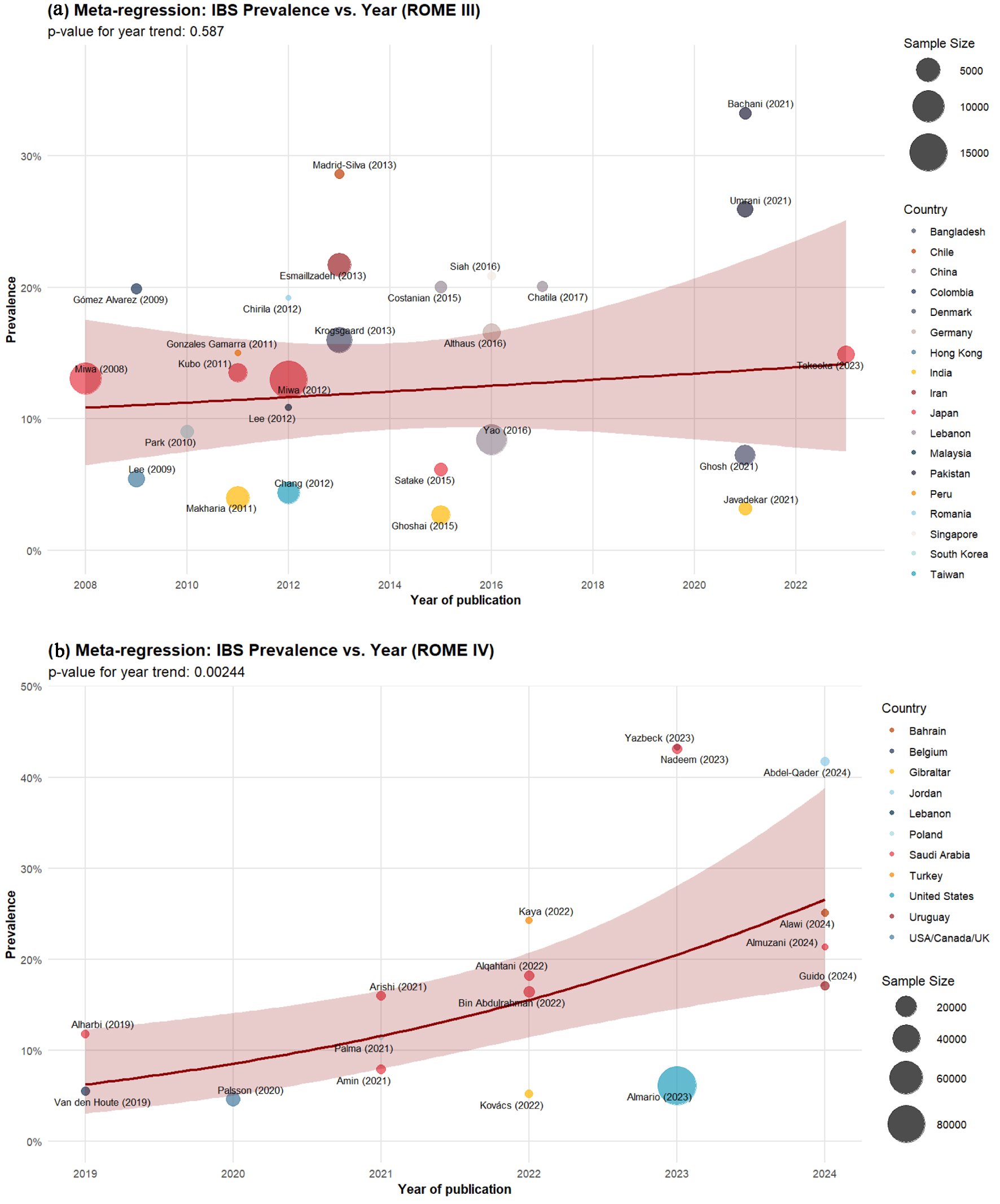
Results: Forty-three studies (26 Rome III, 17 Rome IV) with 188,885 participants were included. The global prevalence was 13.21% (95% confidence interval (CI): 10.70-15.94%) with Rome III and 17.14% (95% CI: 12.00-22.99%) with Rome IV. When considering only studies with probabilistic sampling, prevalences adjusted to 11.19% and 13.28%, respectively. Higher prevalence was found in women (Rome III: 15.69% vs. 11.10% in men; Rome IV: 20.17% vs. 11.45%). Meta-regression showed a trend toward increased prevalence in recent years.
Conclusion: Rome IV showed a higher prevalence than Rome III, possibly due to a more precise definition of abdominal pain. The heterogeneity found suggests the need to standardize methodologies and conduct more studies with probabilistic sampling, especially in underrepresented regions.
Published
Issue
Section
License
Copyright (c) 2025 The authors

This work is licensed under a Creative Commons Attribution-NonCommercial 4.0 International License.