

Safety and Efficacy of Fixed-Dose Pantoprazole and Sustained Release Levosulpiride for Short-Term Management of Gastroesophageal Reflux Disease
DOI:
https://doi.org/10.14740/gr2117Keywords:
GERD, Pantoprazole, Levosulpiride, FSSG, Likert Scale, CGI-I, CGI-S, MSASAbstract
Background: Gastroesophageal reflux disease (GERD) and dyspepsia are highly prevalent in India. Pantoprazole suppresses gastric acid secretion by inhibiting H+, K+-ATPase enzyme, yet patients experience inadequate symptom control with proton pump inhibitor (PPI) monotherapy. Levosulpiride, a selective dopamine D2 receptor antagonist, enhances gastrointestinal motility and visceral sensitivity, offering additional symptomatic relief. The aim of the study was to evaluate the safety and efficacy of a fixed-dose combination (FDC) of pantoprazole sodium 40 mg and levosulpiride sustained-release 75 mg for short-term therapy of GERD in patients unresponsive to PPI monotherapy.
Methods: This phase IV, open-label, single-arm study was conducted at 11 sites across India. Of 540 screened patients, 509 were enrolled and received FDC once daily for 4 weeks. Safety was evaluated through adverse events (AEs) and serious AEs (SAEs). Efficacy was assessed using the Frequency Scale for the Symptoms of GERD (FSSG), Likert Scale, Clinical Global Impression of Improvement (CGI-I), Clinical Global Impression of Severity (CGI-S), and Modified Simpson Angus Scale (MSAS).
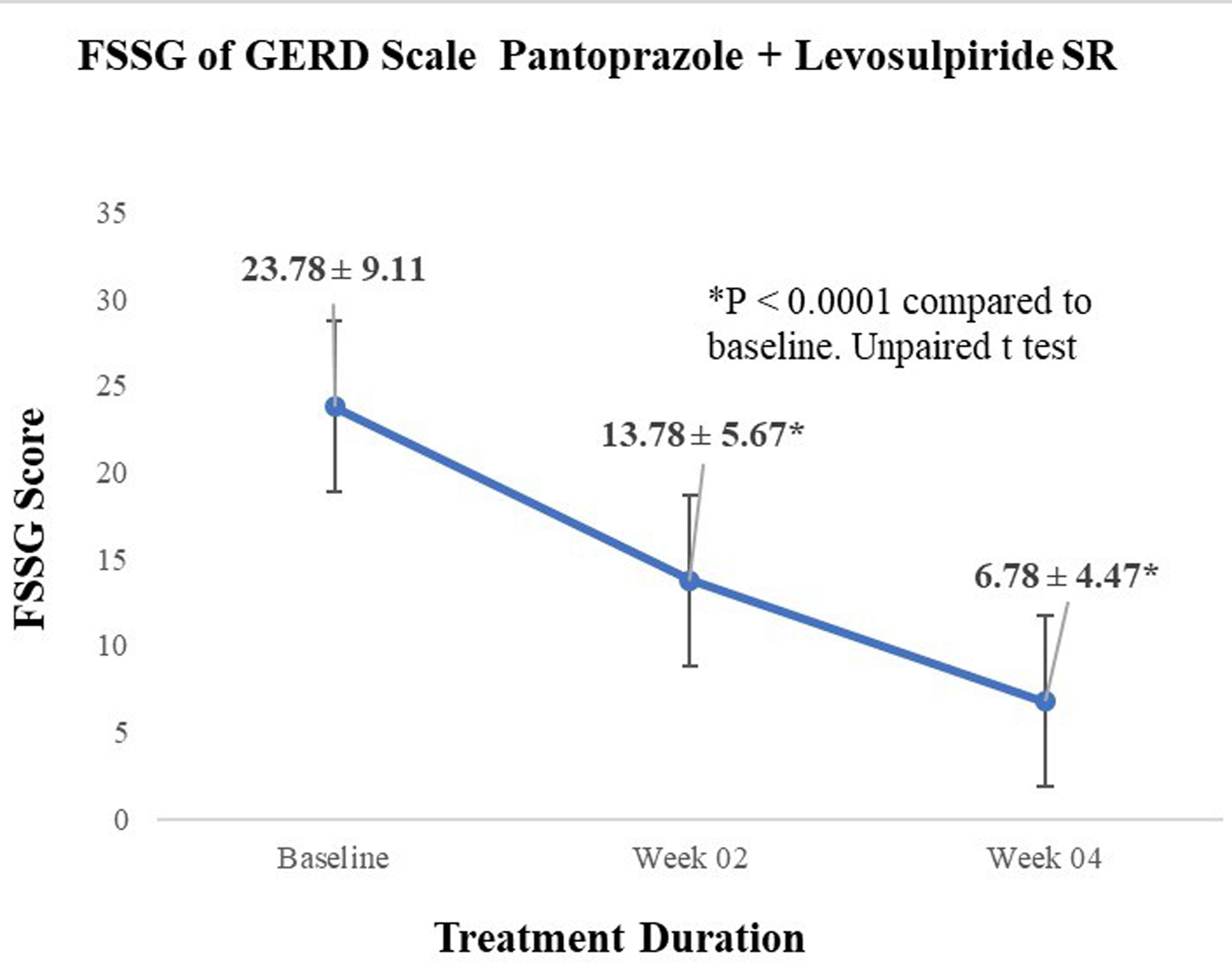
Results: Of 509 patients, 492 completed the study. Seventy-nine AEs were documented in 69 patients, all mild-to-moderate and no SAEs were reported. The FDC demonstrated significant reduction in GERD symptom severity, with a mean (standard deviation) change from baseline of −16.99 (8.76) (P < 0.0001) on FSSG Scale at visit 4. Additionally, reductions were observed in acid reflux symptoms with a mean (SD) change from baseline of −9.15 (5.25) and dyspeptic symptoms −7.8 (4.05); both changes were statistically significant (P < 0.0001). The Likert Scale also demonstrated a significant reduction in symptom severity indicated by a mean (standard deviation) change from baseline of −1.26 (1.00) (P < 0.0001). At visit 4, CGI-I scores classified 196 patients as “very much improved”, while CGI-S indicated “normal” status in 173 patients. The absence of significant movement disorders, assessed by MSAS at visit 4, further supports the favorable safety profile of FDC in management of GERD.
Conclusion: The FDC of pantoprazole and levosulpiride is well tolerated and effective for the short-term treatment of GERD in patients unresponsive to PPI therapy. Symptom reductions and favorable global assessments indicate therapeutic benefit of therapy in refractory GERD population.
Published
Issue
Section
License
Copyright (c) 2026 The authors

This work is licensed under a Creative Commons Attribution 4.0 International License.