

Emergency Department Presentation Prior to Diagnosis of Gastroesophageal Cancer: Clinical Characteristics, Diagnostic Timelines, and Survival Outcomes
DOI:
https://doi.org/10.14740/gr2191Keywords:
Gastroesophageal cancer, Emergency department, Emergency presentation, Diagnostic timeline, Upper gastrointestinal bleeding, Overall survivalAbstract
Background: Emergency department (ED) presentation may represent an important pathway to the diagnosis of gastroesophageal cancer, yet the characteristics of these presentations and their association with outcomes remain poorly described.
Methods: We conducted a retrospective cohort study of patients presenting to the University Health Network (UHN) EDs in Toronto, Canada, between June 1, 2020, and May 1, 2025, who were subsequently diagnosed with gastric or esophageal cancer following ED-initiated investigations. Data were extracted from an institutional clinical database. Demographic and clinical variables included age, sex, Eastern Cooperative Oncology Group (ECOG) performance status, Charlson Comorbidity Index (CCI), stage, treatment receipt, and Gustave Roussy Immune Score (GRIm-Score). Presenting symptoms were abstracted from triage documentation. Overall survival (OS) was estimated using Kaplan–Meier methods.
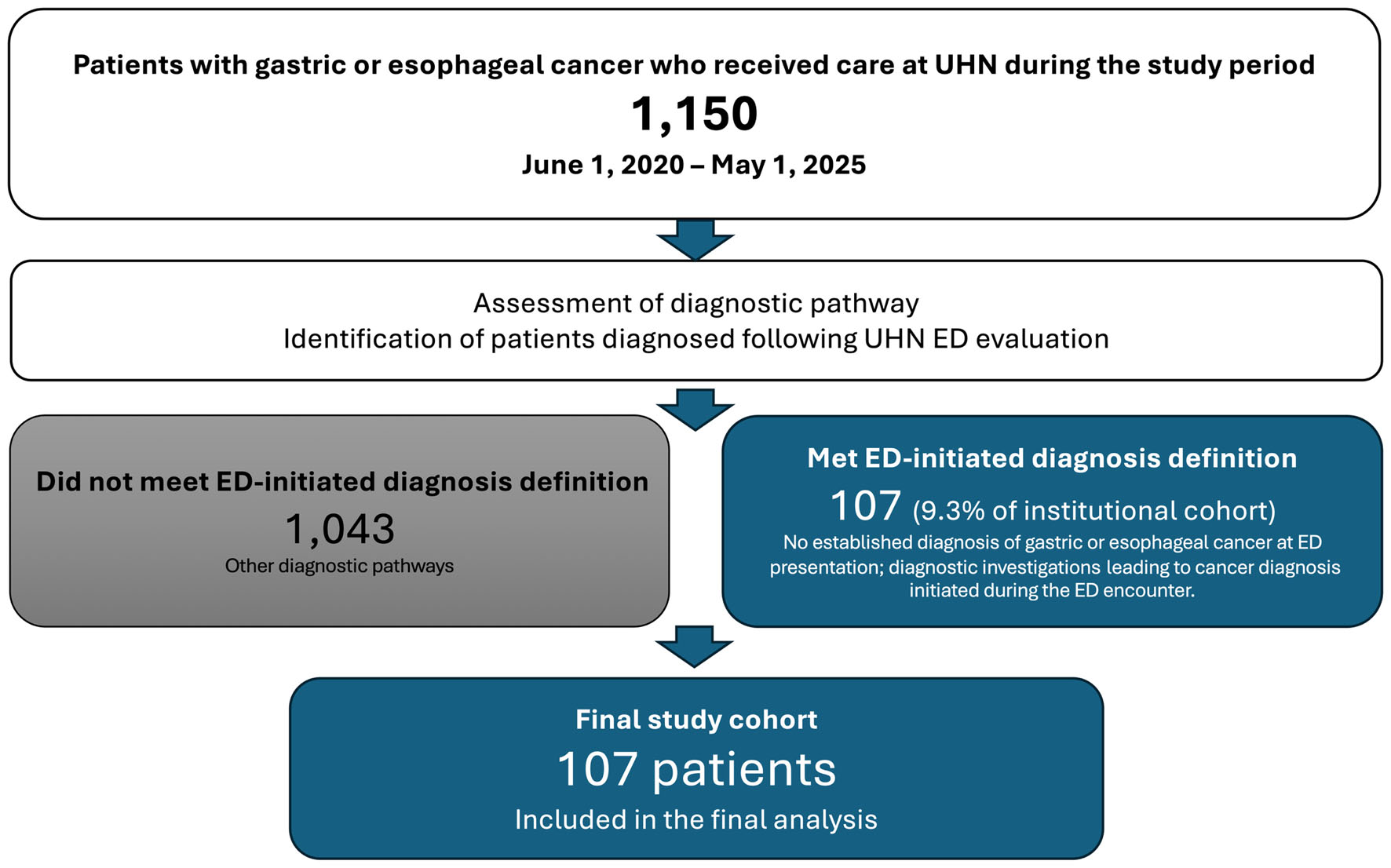
Results: Of 1,150 patients with gastroesophageal cancer seen at UHN during the study period, 107 patients (9.3%) were included (median age 73 years; 78% male). Most had ECOG 0–1 (69%), and median CCI was 4. Gastric cancer accounted for 57% of cases, and 54% presented with metastatic disease. Abdominal pain was the most common presenting symptom in gastric cancer (43%), while dysphagia predominated in esophageal cancer (43%). Sixteen patients (15%) presented with upper gastrointestinal bleeding symptoms. Median time from ED presentation to diagnosis was 4 days (interquartile range (IQR) 2–10). Among the 85 patients (79%) who received cancer-directed therapy, the median time from ED presentation to treatment initiation was 44 days (IQR 22–64). Median follow-up was 7.3 months (IQR 3.2–16.9), and median OS was 10.6 months (95% confidence interval (CI) 6.5–19.0). Estimated 2-year OS was numerically lower among patients with bleeding-related presentations than among those without (21% vs. 35%), although estimates were imprecise due to the small subgroup size. Survival appeared numerically lower among bleeding presentations with anemia, although estimates were imprecise due to small numbers.
Conclusions: ED presentation provides an important clinical context for the diagnosis of gastroesophageal cancer. This cohort was characterized by a high prevalence of advanced-stage disease and limited OS. Further investigation is warranted to better understand presenting symptom patterns and early clinical markers that may help identify patients with adverse oncologic outcomes.
Published
Issue
Section
License
Copyright (c) 2026 The authors

This work is licensed under a Creative Commons Attribution 4.0 International License.