

A Supervised, Online, Home-Based Eccentric Resistance Exercise Program for Patients With Metabolic Dysfunction-Associated Steatotic Liver Disease
DOI:
https://doi.org/10.14740/gr2131Keywords:
Controlled attenuation parameter, Liver stiffness, Liver enzyme, Lipid profile, Physical function test, Exercise adherenceAbstract
Background: Metabolic dysfunction-associated steatotic liver disease (MASLD) is the most common non-communicable chronic liver disease worldwide, increasing long-term risk of cirrhosis, type 2 diabetes mellitus, and cardiovascular diseases. Although reducing liver steatosis by increasing physical activity can lower these risks, patients with MASLD often struggle to exercise regularly. We examined the effects of a supervised, home-based, online bodyweight eccentric exercise program on liver and metabolic markers, and physical fitness in patients with MASLD.
Methods: Sixteen adults with MASLD (24–91 years) were assigned to an exercise group (n = 9) or a control group receiving lifestyle counselling (n = 7). The exercise group participants performed an online progressive bodyweight eccentric exercise program targeting trunk, leg, and arm muscles for 5 to 25 min per session, 5 days a week, for 8 weeks. Outcome measures included severity of hepatic steatosis (controlled attenuation parameter (CAP)), anthropometric measures (waist and hip circumferences), liver enzymes, and physical function tests, which were assessed at baseline and after the 8-week period.
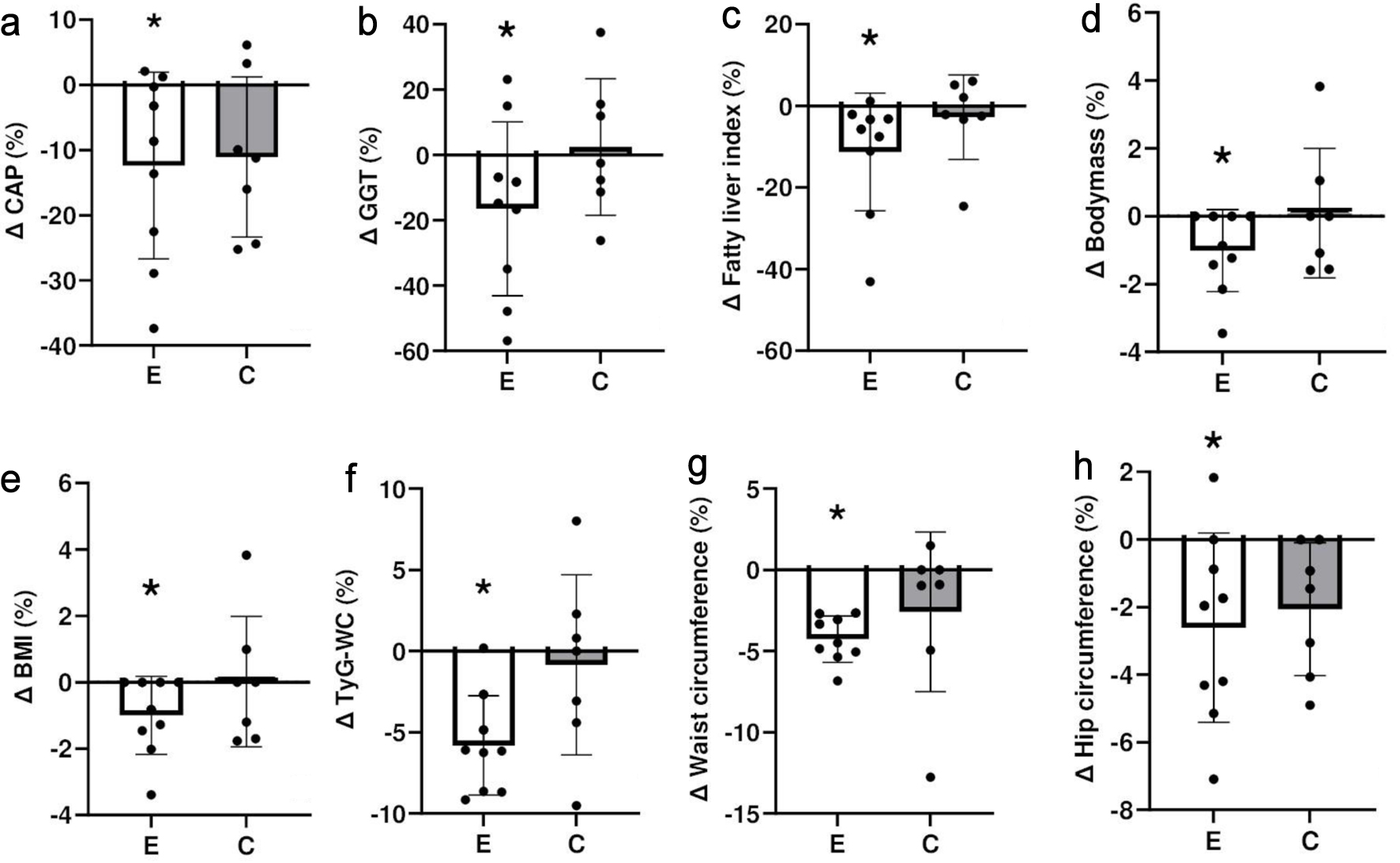
Results: All participants in the exercise group completed 40 exercise sessions, and showed reductions in CAP (−13.2±13.8%, P = 0.03), waist circumference (−4.4±13.5%, P = 0.007), hip circumference (−2.6±11.1%, P = 0.03), and serum gamma-glutamyl transferase (−23.9±30.0%, P = 0.03), which were not evident in the control group. Physical fitness of the exercise group participants improved, including the sit-to-stand (24.3±33.2%, P = 0.03), 3-m timed up and go (−15.6±16.4%, P = 0.01), 2-min step test (37.5±20.5%, P = 0.008), and single-leg balance (25.1±37.6%, P = 0.04).
Conclusion: The exercise program was effective in reducing hepatic steatosis and increase physical fitness in patients with MASLD, highlighting the efficacy of the home-based eccentric exercise program in enhancing liver and metabolic health.
Published
Issue
Section
License
Copyright (c) 2026 The authors

This work is licensed under a Creative Commons Attribution 4.0 International License.