

Artificial Intelligence-Assisted Colonoscopy Improves Adenoma Detection by Trainee and Less-Experienced Endoscopists: A Systematic Review and Meta-Analysis of Randomized Controlled Trials
DOI:
https://doi.org/10.14740/gr2183Keywords:
Computer-aided detection, Deep learning, Proximal colon, Gastroenterology fellowship, Colorectal cancer screening, Endoscopy education, Quality indicators of colonoscopy, Post-colonoscopy colorectal cancerAbstract
Background: Multiple systematic reviews and meta-analyses have established the benefits of computer-aided detection (CADe) among experienced endoscopists. The role of CADe among endoscopists who are still acquiring competence trainees in formal endoscopic training and independently practicing but less-experienced operators particularly its effect on right-colon adenoma detection, remains incompletely defined. We performed an updated systematic review and meta-analysis of randomized controlled trials (RCTs) to evaluate the impact of CADe on adenoma detection by trainee and less-experienced endoscopists.
Methods: We searched PubMed/MEDLINE, Embase, the Cochrane Central Register of Controlled Trials, and ClinicalTrials.gov from inception through May 2026 for RCTs comparing CADe-assisted with standard colonoscopy performed by trainee or less-experienced endoscopists. The primary outcome was adenoma detection rate (ADR). Secondary outcomes were right-colon ADR (RADR), polyp detection rate (PDR), and advanced adenoma detection rate (AADR). Risk ratios (RRs) were pooled using DerSimonian–Laird random-effects models; heterogeneity was quantified with I2. Ninety-five percent prediction intervals (PIs), pooled risk differences (RDs), Hartung–Knapp confidence intervals (CIs), leave-one-out sensitivity analyses, a prespecified sensitivity analysis restricted to operators in formal training, Doi plots with the Luis Furuya-Kanamori (LFK) index, and Grading of Recommendations, Assessment, Development and Evaluation (GRADE) certainty ratings were also generated.
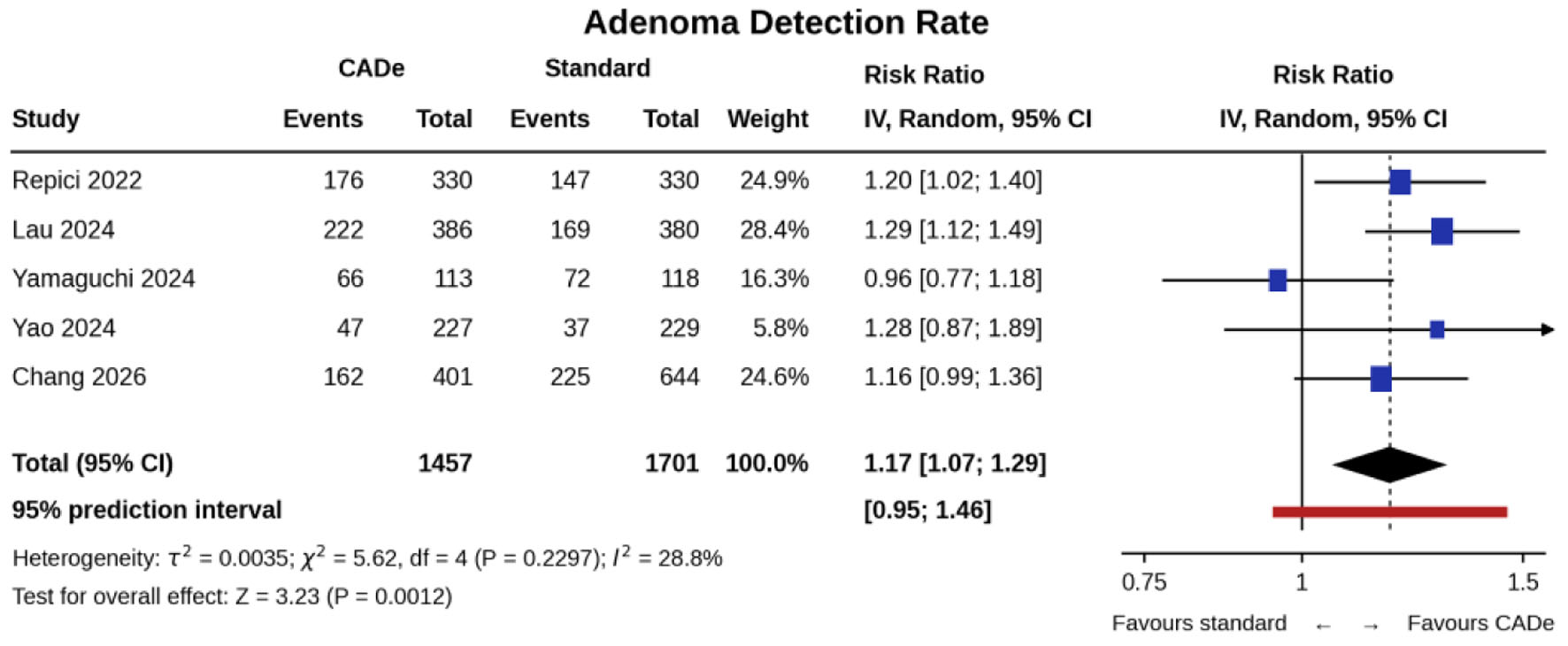
Results: Five RCTs enrolling 3,158 patients met the inclusion criteria. CADe significantly increased overall ADR (RR 1.17, 95% CI 1.07–1.29; P = 0.0012; I2 = 28.8%; 95% PI 0.95–1.46; RD +6.9%, 95% CI +2.7% to +11.0%; number needed to treat (NNT) 15). The effect was larger for RADR (RR 1.31, 95% CI 1.14–1.50; P = 0.0002; I2 = 26.6%; 95% PI 0.86–1.97; RD +8.2%, 95% CI +4.6% to +11.7%). PDR was also higher with CADe (RR 1.16, 95% CI 1.08–1.25; P = 0.0001; I2 = 27.8%; 95% PI 0.97–1.39). AADR did not differ between groups (RR 0.97, 95% CI 0.73–1.29; P = 0.82; I2 = 0.0%; 95% PI 0.52–1.81). Results were robust to leave-one-out analysis and to exclusion of the single trial of independently practicing non-expert operators (ADR RR 1.16, 95% CI 1.01–1.33). Certainty of evidence was moderate for ADR, low for RADR and PDR, and very low for AADR.
Conclusions: CADe-assisted colonoscopy increases adenoma detection by trainee and less-experienced endoscopists, with the largest relative effect for right-colon adenomas. Because the PIs cross the null and the certainty of evidence is moderate at best, these findings support further prospective evaluation of CADe as an adjunct to colonoscopy training rather than establishing that routine integration into fellowship curricula produces more competent independent endoscopists.
Published
Issue
Section
License
Copyright (c) 2026 The authors

This work is licensed under a Creative Commons Attribution 4.0 International License.