

Effectiveness of a Natural-Rubber Anal Dilator (ParaSelf) After Pediatric Anorectal Surgery: A Historical-Controlled Intervention Study
DOI:
https://doi.org/10.14740/gr2124Keywords:
Stenosis, Dilation, Anorectal malformations, Hirschsprung disease, RubberAbstract
Background: Anal stenosis is a frequent complication after anorectal reconstruction for anorectal malformation (ARM) or Hirschsprung disease (HD). Conventional rigid dilators are uncomfortable, expensive, and poorly adapted to pediatric anatomy. Natural rubber dilators may offer better conformity and outcomes but have not been evaluated. The aim of the study was to compare the efficacy and safety of ParaSelf, a natural rubber-based anal dilator, with conventional rigid dilators in children after anorectal surgery.
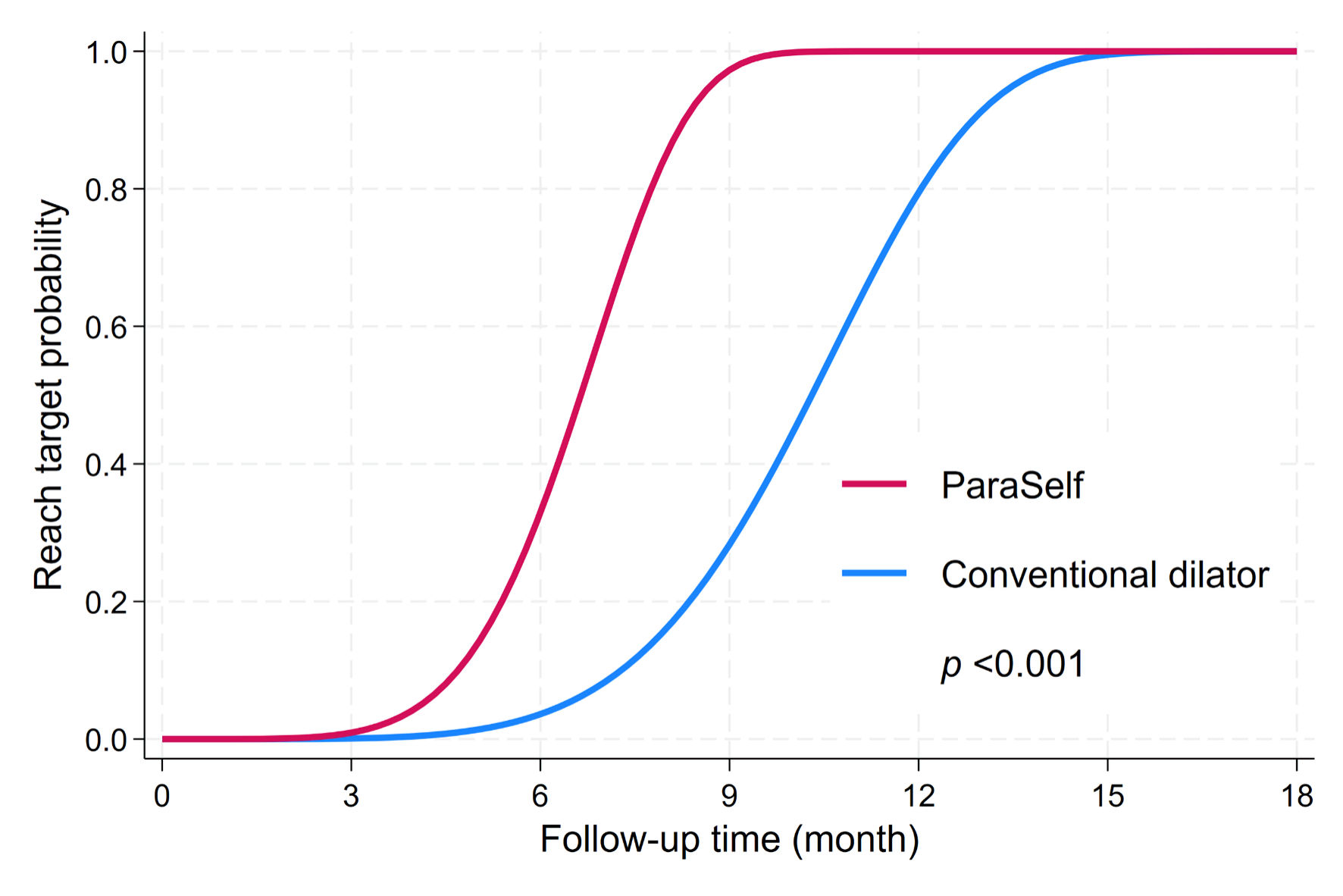
Methods: This retrospective cohort study included 98 children with ARMs or HD. Children who used conventional dilators during 2017–2022 served as the preimplementation control cohort, and children who used ParaSelf during 2022–2025 comprised the post-implementation cohort. The primary endpoint was time to achieve the age-specific target anal diameter, analyzed using multivariable Weibull parametric proportional hazards regression. Secondary endpoints included anal stenosis (including surgery-requiring stenosis), pain, caregiver satisfaction, and major postoperative complications.
Results: Of 98 patients, 33 (33.7%) received ParaSelf. The ParaSelf group reached the target diameter faster than controls (median 5.6 vs. 9.4 months). Weibull regression showed a nearly 10-fold higher hazard of reaching the target diameter with ParaSelf (hazard ratio (HR) = 9.9; 95% confidence interval (CI), 5.2 to 18.7; P < 0.001). Pain scores during home dilation were lower (median difference = −2.58; 95% CI, −3.40 to −1.76; P < 0.001), and caregiver satisfaction was higher (median difference = 2.00; 95% CI, 1.52 to 2.48; P < 0.001) with ParaSelf versus conventional dilators. No irritation, bleeding, leakage, or surgery-requiring stenosis occurred in the ParaSelf group.
Conclusions: ParaSelf was associated with faster dilation, less pain, fewer complications, and higher caregiver satisfaction than conventional dilators and may be a more acceptable alternative for pediatric anorectal reconstruction.
Published
Issue
Section
License
Copyright (c) 2026 The authors

This work is licensed under a Creative Commons Attribution 4.0 International License.